


Medicare Part D late enrollment penalty appeal: How much could you owe
A Medicare Part D late enrollment penalty can apply after at least 63 continuous days without Part D or creditable prescription drug coverage when you’re eligible to enroll after your initial enrollment period, according to the Centers for Medicare & Medicaid Services. If you’ve received a penalty notice, you can appeal the decision that it applies or challenge how the amount was calculated.
It’s understandable to worry that a gap in coverage automatically means a lasting extra charge. The details matter: qualifying prescription drug coverage may prevent a penalty, while the length of an uncovered period helps determine its amount. This guide explains when Medicare may assess the penalty, how it is calculated, how creditable coverage affects your situation, and what to consider if you believe the decision is wrong. Understanding the rules can help you identify your next step.
Periods without creditable prescription drug coverage
A break in prescription drug coverage matters because its length and your eligibility can affect whether Medicare assesses a penalty.
Gaps in Creditable Drug Coverage
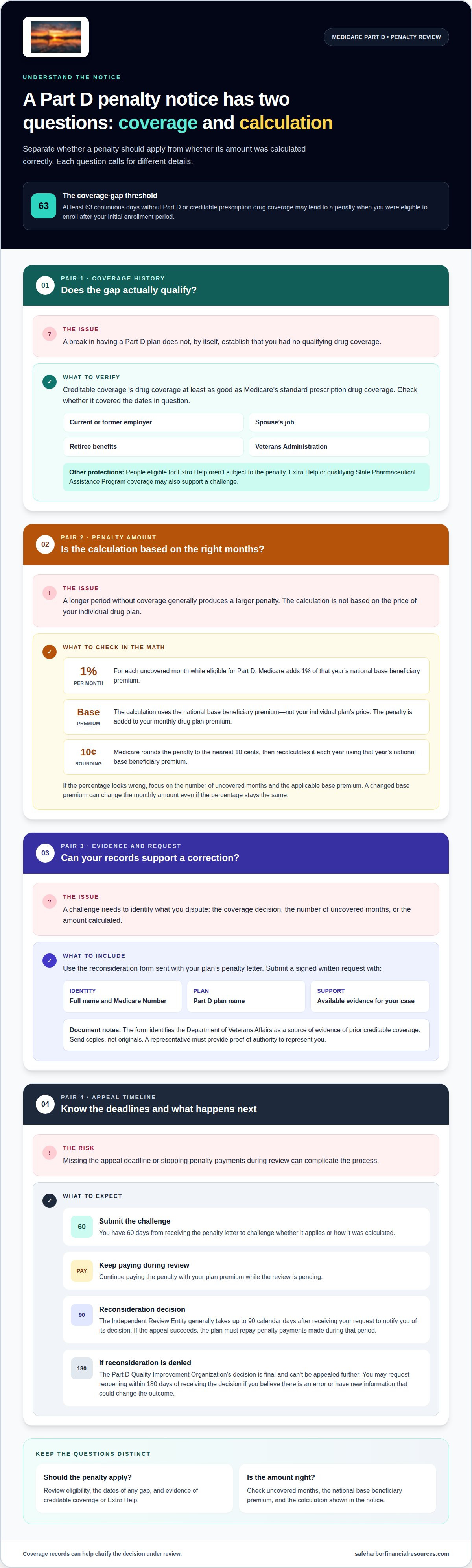
A gap is a continuous period without a Part D plan or creditable prescription drug coverage. Creditable coverage means drug coverage that is at least as good as Medicare’s standard prescription drug coverage. Coverage through a current or former employer, a spouse’s job, retiree benefits, or the Veterans Administration may qualify. What matters is whether it covered the period in question. A gap can affect both whether a penalty applies and how it is calculated.
Creditable Coverage and Extra Help Exemptions
Creditable coverage can prevent a penalty for the period it covers. Extra Help also protects eligible beneficiaries from the Part D late enrollment penalty. People eligible for Extra Help aren’t subject to the penalty, and those receiving it should have the penalty waived. If you received Extra Help or coverage through a qualifying State Pharmaceutical Assistance Program, that information may support a challenge. What matters is your coverage status, not simply whether you had a prescription drug plan.
The 63-Day Coverage Gap Threshold
The threshold is a continuous period of at least 63 days without Part D enrollment or creditable prescription drug coverage. According to the Centers for Medicare & Medicaid Services, a beneficiary may incur a penalty after that period when eligible to enroll after the initial enrollment period. A shorter gap doesn’t meet this stated threshold. To understand a notice, consider whether qualifying coverage existed during the gap and whether the dates were counted correctly.
Evidence and Documents for a Challenge
To challenge a penalty, use the reconsideration form sent with your plan’s penalty letter. Submit a signed written request with your full name, Medicare Number, and Part D plan name, along with any available evidence supporting your case. The form identifies the Department of Veterans Affairs as a source of evidence of prior creditable prescription drug coverage. Send copies, not original documents. If a representative submits the request, they must provide proof of their authority to represent you. These details help identify which coverage period or penalty determination you’re challenging.
How the penalty is calculated
The Part D late enrollment penalty uses the number of uncovered months and the national base beneficiary premium. For each month without Part D or creditable drug coverage while eligible for Part D, Medicare adds 1% of that year’s base premium. The resulting amount is added to your monthly drug plan premium.
The percentage reflects the number of uncovered months, so a longer gap generally results in a larger penalty. The calculation uses the base premium, not the price of your individual drug plan.
Rounding also matters. Medicare rounds the penalty to the nearest 10 cents, then recalculates it each year using that year’s national base beneficiary premium. A change in the base premium can therefore change the monthly penalty even when the percentage stays the same.
Your penalty letter shows the amount applied to your coverage. A reconsideration can challenge whether the penalty applies or how Medicare calculated it. If the listed percentage seems wrong, focus on the number of uncovered months and the applicable base premium. If you believe the penalty shouldn’t apply at all, consider whether your enrollment history or coverage evidence could change the determination. Separating these questions can help you focus your appeal on the specific calculation or decision you dispute.
When Medicare may assess a Part D late-enrollment penalty
Medicare generally considers enrollment late if you don’t join a drug plan within three months after first getting Original Medicare Parts A and B. If you later receive a penalty notice, it explains how to appeal and includes a form. You have 60 days from receiving the letter to challenge whether the penalty applies or how it was calculated.
The penalty can increase your monthly premium in addition to your plan’s other charges. In most cases, it continues for as long as you have Medicare drug coverage, even if you switch Part D plans. Review the notice carefully: a dispute about your coverage history is different from a dispute about the penalty calculation.
A Medicare Part D late enrollment penalty appeal generally takes up to 90 calendar days for the Independent Review Entity to notify you of its reconsideration decision after receiving your request. Continue paying the penalty with your plan premium while the review is pending. If the appeal succeeds, the plan must repay penalty payments made during that period.
If reconsideration is denied, the Part D Quality Improvement Organization’s decision is final and can’t be appealed further. You may request reopening within 180 days of receiving the decision if you believe it contains an error or have new information that could change the outcome. The takeaway: meet the initial 60-day appeal deadline, keep paying during review, and preserve relevant coverage records.
If the notice raises questions about your Medicare drug plan choices, review your Medicare coverage options before making a change.
Safe Harbor Financial Resources
Safe Harbor Financial Resources helps people understand Medicare coverage choices and how they fit their insurance needs. After reviewing a Part D penalty notice and your coverage history, you may also need to consider which Medicare plan options suit your situation. Clear guidance can help you understand those choices while keeping plan selection separate from the reconsideration process.
Its guidance on Medicare plans and supplements can be useful when you’re weighing prescription drug coverage alongside other Medicare coverage. The right next step depends on what you want your coverage to do and how your needs fit together. If you’d like to discuss your Medicare options, contact Safe Harbor Financial Resources.
Take the next step toward confident coverage decisions
A Medicare Part D late enrollment penalty appeal concerns a specific coverage decision. You can also consider how your broader insurance needs fit together, without letting a penalty notice alone dictate every choice. Keep the appeal process separate from other coverage decisions, and weigh each option based on what that coverage is intended to do.
Safe Harbor Financial Resources offers Medicare Supplement Insurance (Medigap), Life Insurance with Living Benefits, and Term Life Insurance. If you’d like guidance on how these options relate to your broader planning, contact Safe Harbor Financial Resources. A thoughtful next step can bring greater clarity to the choices ahead.
Frequently Asked Questions
Looking for reliable Medicare Part D advice?
Safe Harbor Financial Resources provides Medicare guidance to people in Palm Beach Gardens and Palm Beach County. A licensed Medicare specialist can clarify plan choices and how prescription drug coverage fits your situation. If you’re reviewing a penalty notice, keep that reconsideration separate from choosing coverage. Understanding each decision on its own can make your next steps easier to organize.
How is the Medicare Part D late enrollment penalty calculated?
The calculation depends on your eligible uncovered months and the national base beneficiary premium for the applicable year. The uncovered-month count sets the percentage, while the annual base premium determines the dollar amount. Medicare rounds the result to the nearest 10 cents and recalculates it annually. If you’re disputing the amount, focus on whether the month count or calculation inputs are incorrect.
What qualifies as creditable prescription drug coverage to avoid the Part D late enrollment penalty?
Coverage qualifies as creditable when it’s at least as good as Medicare’s standard prescription drug coverage. It may come through an employer, a spouse’s job, retiree benefits, or the Veterans Administration. For example, employer coverage may count even if it isn’t a Part D plan. Keep the coverage dates and any notice describing its creditable status to support your account of the period.
Who is exempt from the Medicare Part D late enrollment penalty?
People eligible for Medicare Extra Help aren’t subject to the Part D late enrollment penalty, and people receiving Extra Help should have the penalty waived. Creditable prescription drug coverage also prevents a penalty for the period it covers. A State Pharmaceutical Assistance Program may be relevant if its coverage is creditable; assistance from a program may also help pay a beneficiary’s penalty.
What circumstances qualify for a Medicare Part D late enrollment penalty reconsideration?
A Medicare Part D late enrollment penalty appeal may challenge the decision or its calculation if you believe Medicare assessed the penalty by mistake. Relevant circumstances include prior creditable coverage, inadequate information about whether coverage qualified, Extra Help, or creditable State Pharmaceutical Assistance Program coverage. A serious medical emergency, inability to enroll during the period stated by your plan, or an incorrectly identified end date for your Initial Enrollment Period may also support reconsideration.



Comments