


Life insurance for stay-at-home parents in Florida: coverage
A stay-at-home parent’s unpaid work has real financial value, and replacing it can create a substantial expense for a family. Here at Safe Harbor Financial Resources, we know that for life insurance for stay-at-home parents in Florida, a 15- to 20-year term policy with at least $500,000 in coverage is one starting point to consider for Palm Beach Gardens and Palm Beach County households. The right amount depends on the care, household support, debts, and housing costs your local family would need to replace.
It’s easy to focus on the income a household would lose, but caregiving and daily responsibilities matter too. This guide explains how term and permanent life insurance may fit, how to estimate useful coverage, and how to account for unpaid care so you can plan effectively for your family.
What type of life insurance should a stay-at-home parent get?
For Florida families, the right fit depends on whether protection is needed during the child-raising years or for life. Term life covers a set period, while whole and universal life are permanent options.
Childcare Costs After a Parent’s Death
Childcare costs are the expenses of replacing care a parent provided at home. A surviving spouse may also need help with school pickups, meals, and activities. Include these costs in coverage estimates, alongside housing, debt, and funeral expenses.
Replacing Unpaid Care and Household Work
Unpaid care and household work can include childcare, transportation, meal preparation, and home management. A death benefit can give a surviving spouse funds to arrange paid support and manage household responsibilities. For example, some funds could go toward childcare and others toward transportation or meal help. Consider how long children may need that support.
Term life may fit needs tied to a mortgage or the years children are growing up. Whole life builds cash value and has fixed premiums. Universal life offers flexibility in premiums and death benefits while building cash value.
Choose beneficiaries carefully. If children are minors, consider how an adult would manage their inheritance, such as through a trust arrangement, and coordinate beneficiary choices with your estate plans.
Florida life insurance rates do not have a fixed comparison with national rates. Premiums depend on factors such as age, health, policy type, term, and coverage amount.
Savings, debt repayment, and an employed spouse’s workplace coverage can also help protect a Florida family. These resources may provide funds, but they do not replace ongoing caregiving on their own.
Life insurance benefits are generally not taxable as income. Florida tax and inheritance treatment can depend on the policy and family circumstances, so consider how ownership and beneficiary arrangements may affect access to the benefit.
Estimating coverage needs
Estimate coverage based on the care and household support your family would need to replace.
Estimating a Stay-at-Home Parent’s Coverage
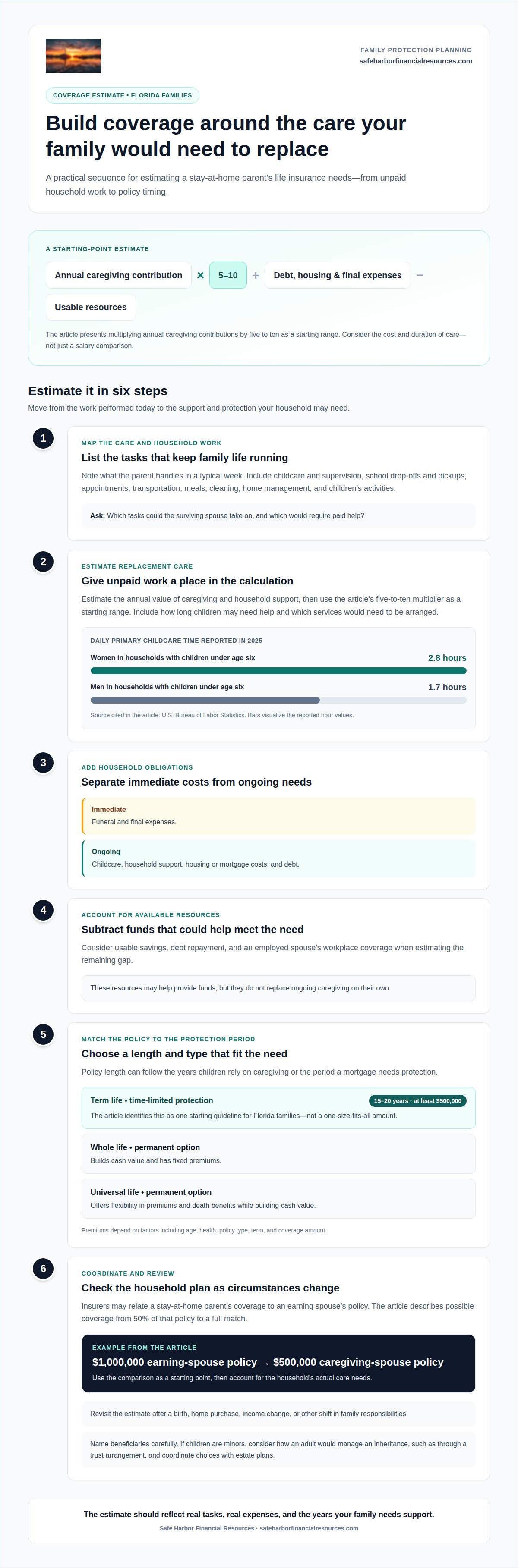
Estimate the support your household would need to replace after a parent’s death. Multiply annual caregiving contributions by five to ten as a starting range. Include cleaning, transportation, meals, and the years children may need support. Add debt, housing, and funeral expenses, then subtract usable resources. Set the benefit with the cost of care in mind.
Coverage Timing and Policy Length
Policy length should match the years children rely on caregiving. One guideline recommends 15- to 20-year term life insurance with at least $500,000 coverage. Buying younger and healthier typically costs less, making family changes useful review points. Revisit coverage after a birth, home purchase, or income change. A longer term may extend protection.
Coordinating Coverage With an Earning Spouse’s Policy
Insurers may relate a stay-at-home parent’s coverage to the earning spouse’s policy. Possible amounts range from 50% of that policy to a full match. For example, a $1,000,000 policy may correspond to $500,000 for the caregiving spouse. Treat that comparison as a starting point, then account for household care needs.
Qualifying Without Personal Income
Yes, a stay-at-home parent can seek coverage without personal income. Estimate household needs based on caregiving duties, debts, and the earning spouse’s income. To apply in Florida, choose an amount and term, name beneficiaries, and submit an insurer application. Comparing term life options can provide a practical starting point.
The financial value of stay-at-home parenting
Yes, stay-at-home parents in Florida may need life insurance if their death would leave unpaid care and household work to replace. The financial value is not limited to a salary; it also includes the daily tasks that keep family life running.
In 2025, according to the U.S. Bureau of Labor Statistics, women in households with children under age six spent 2.8 hours providing primary childcare on an average day, compared with 1.7 hours for men. That time represents valuable care, even when no paycheck records it. A surviving parent may have to reorganize work, school transportation, meals, and supervision.
To understand the financial impact, list the responsibilities the parent handles in a typical week. Include school drop-offs, appointments, cleaning, meal preparation, and support for activities. Then consider which tasks the surviving spouse can take on and which would require paid help. This makes the estimate reflect your family’s situation rather than relying only on a salary comparison.
Coverage can provide funds to replace those services while the family adjusts. It may also help with mortgage payments, debt, and final expenses. Separate immediate needs, such as funeral expenses, from ongoing needs, such as childcare and household support. The value of care changes as children grow, so revisit your estimate when school, work, or family responsibilities change.
A practical takeaway: identify what your household would need to pay for if that parent were no longer there. This connects coverage to real tasks and expenses, not an assumed income. A life insurance benefit can give the surviving parent room to make decisions without immediately replacing every responsibility at once.
Safe Harbor Financial Resources: Medicare Supplement Insurance (Medigap)
Safe Harbor Financial Resources helps families explore life insurance options, including Term Life Insurance and Whole Life Insurance. These policies may suit different protection goals, such as covering needs during the child-raising years or planning for longer-term security.
Medicare Supplement Insurance (Medigap) addresses a different need: supplemental health coverage alongside Medicare. For a stay-at-home parent’s life insurance decision, focus on caregiving responsibilities, household expenses, and the coverage period your family wants to protect. Life Insurance with Living Benefits is another option to discuss as part of broader planning.
If you’re ready to consider how these options fit your family’s priorities, contact Safe Harbor Financial Resources for a free consultation.
Make your family’s next step a thoughtful one
Your family’s needs can change as children grow, work plans shift, or household responsibilities evolve. Revisit your protection choices after a meaningful life change, and keep beneficiary information aligned with your family’s current plans.
Choosing life insurance for stay-at-home parents in Florida is one part of protecting the care and stability your household depends on. Safe Harbor Financial Resources offers Term Life Insurance and Life Insurance with Living Benefits, as well as Medicare Supplement Insurance (Medigap) for separate Medicare coverage needs.
To discuss which coverage may fit your priorities, contact Safe Harbor Financial Resources. A clear next step can help you move forward with greater confidence.
Frequently Asked Questions
How can you calculate the economic value of a stay-at-home parent's unpaid work?
Start by listing the recurring tasks the parent handles, such as childcare, cooking, cleaning, transportation, and appointments. Estimate the time needed for each task, then apply a reasonable replacement rate to calculate the annual total. Adjust for tasks the surviving parent can manage, and consider how long paid help may be needed as children grow.
What is the average cost of term life insurance for a stay-at-home parent in Florida?
Term premiums are priced individually and provided after a quote request. For life insurance for stay-at-home parents in Florida, the amount depends on the applicant’s age and health, chosen coverage amount, and policy term. Compare proposals with matching benefit amounts and durations, since different coverage designs can make monthly premiums difficult to compare at first.
What life insurance policy types are best for stay-at-home parents: term or whole life?
The better fit depends on whether the family’s main need has a clear end point. Term coverage can align with a period of financial responsibility, such as while children depend on parental care. Whole life may suit families seeking lifelong coverage. Compare each policy’s duration and payment structure with your household budget and longer-term plans.
What factors affect life insurance premiums for Florida parents?
Premiums reflect the insurer’s assessment of the applicant and policy design. Age, health history, tobacco use, requested benefit, and coverage duration can influence underwriting. Provide accurate application details, then compare policies with the same benefit and term. This helps distinguish premium differences from differences in the protection being considered.
Are life insurance benefits taxable in Florida, and what happens under Florida law?
Life insurance benefits are generally not taxable as income. Florida tax and inheritance treatment can depend on the policy and family circumstances, and ownership and beneficiary arrangements may affect access to the benefit.



Comments