


Creating a Personal Pension with an Annuity for Retirement Income
Creating a personal pension with an annuity means using savings to buy a contract that can provide regular retirement income. An annuity contract requires regular payments for more than one full year to the person entitled to receive them, called the annuitant. Unlike a traditional employer pension, it’s an arrangement you can build around your own savings and income needs.
It’s natural to want dependable retirement payments and to wonder what happens to them after you die. Annuity choices can affect both your income and whether payments continue to a spouse or beneficiaries, so it’s important to understand the options. This guide explains how annuities differ from pensions, how immediate and deferred income work, and how payment periods and beneficiary provisions shape the outcome. You’ll get a clearer picture of how an annuity may fit into a personal retirement income plan and which trade-offs to consider.
What’s the difference between an annuity and a pension?
A pension is a retirement benefit, often provided through an employer plan. An annuity is an insurance contract that can turn savings into regular income for more than one year.
Alongside Social Security, an income annuity can help create a personal pension, including for self-employed people without an employer pension. Planning involves weighing income needs, taxes, healthcare costs, and legacy goals. Joint lifetime income may continue payments to a surviving spouse.
For a clear explanation of how annuities can provide retirement income, watch this video:
Comparing Annuity Income Types
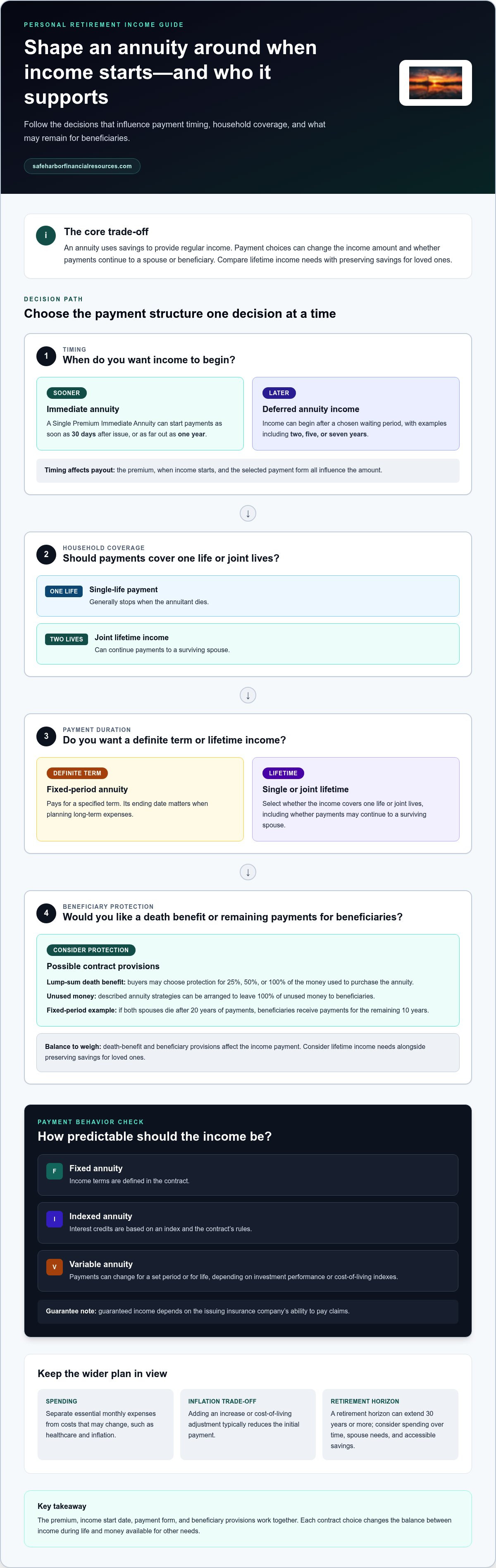
Fixed annuities define income terms in the contract, while indexed annuities base interest credits on an index and the contract’s rules. Variable annuity payments can change for a set period or for life, depending on investment performance or cost-of-living indexes. These differences matter when balancing predictable income alongside Social Security against changing returns. Guaranteed income depends on the issuing insurance company’s ability to pay claims.
Self-employed savers may use an individual retirement account (IRA) to hold an annuity. To buy one, open and fund a traditional or Roth IRA, then use its assets for the annuity premium. IRS Publication 575, Pension and Annuity Income, discusses the tax treatment and reporting of distributions from pension and annuity plans. Traditional IRA distributions are generally taxable; Roth IRA annuity income is tax-free.
Starting Payments and Calculating Payouts
A Single Premium Immediate Annuity can start payments as soon as 30 days after issue, or as far out as one year. Deferred annuity income can begin after periods such as two, five, or seven years. Payouts depend on the premium, when income starts, and the selected payment form, including whether income covers one life or joint lives. Those choices shape household income and spouse continuation.
What If You Want Payments to Continue to Beneficiaries?
Payment choices determine whether income ends at death or continues to a spouse or beneficiary. A single-life payment generally stops when the annuitant dies; joint lifetime income can continue for the surviving spouse. If both spouses die after 20 years of payments, beneficiaries receive payments for the remaining 10 years.
Annuity contracts can also provide death benefits. Buyers may choose a lump sum protecting 25%, 50%, or 100% of the money used to purchase the annuity. Alternatively, the described annuity strategies can be arranged to leave 100% of unused money to beneficiaries. The choice affects the income payment, so weigh lifetime income needs against preserving savings for loved ones.
Employer pensions work differently. A defined benefit plan promises retirement benefits calculated under its plan formula; a defined contribution plan builds an account from contributions and investment results. Pension income also varies by employer type: median annual federal government pension benefits are $26,380, compared with $24,980 for state or local government pensions, $24,130 for military pensions, and $11,040 for private pensions and annuities.
Alternatives to an IRA annuity that may provide lifetime retirement income include Social Security, an employer pension, or an annuity purchased outside an IRA. Compare payment terms and survivor provisions for each source. For an inherited annuity, eligible individual beneficiaries may elect a stretch provision; trusts and other non-natural entities must choose another option.
Using annuities to create a personal pension
Creating a personal pension with an annuity means using retirement savings to establish income outside an employer’s pension plan. An annuity can be purchased independently or with an employer’s help, offering workers and self-employed people another way to structure retirement income. Before committing savings, separate essential monthly expenses from costs that may change, such as healthcare and inflation.
The timing matters. Pension owners often choose a lump sum, periodic payments, or a combination between ages 55 and 65. An immediate annuity can begin paying as soon as 30 days after issue, while a deferred arrangement postpones income. That distinction helps align payments with the point when employment income stops or other retirement benefits begin.
Consider a couple aged 60 and 58 deciding how to divide retirement assets. They can compare lifetime income for one person with joint lifetime payments that continue for a spouse. A fixed period annuity instead pays for a definite term, so its ending date matters when planning long-term expenses. Each contract choice changes the balance between income during life and money available for other needs.
Inflation protection also involves a trade-off: adding an increase or cost-of-living adjustment typically reduces the initial payment and may not make mathematical sense. Variable annuity payments can change with fund profits or cost-of-living indexes. For predictable income, compare those moving payments with fixed contract terms, then determine how much income must remain steady and how much flexibility the rest of the plan needs. A retirement horizon can extend 30 years or more, so build the comparison around spending over time, spouse needs, and accessible savings.
Safe Harbor Financial Resources: Medicare Supplement Insurance (Medigap)
Safe Harbor Financial Resources can help you consider Medicare Supplement Insurance (Medigap) as part of retirement planning. An annuity can structure income, while Medicare coverage addresses a separate concern: healthcare in retirement. Considering both can help you assess how your income plan fits with your healthcare needs.
Legacy and family protection may also shape your financial picture. Safe Harbor Financial Resources offers life insurance with living benefits, term life insurance, and whole life insurance. These differ from annuity income, so consider the role each may play in your broader plans.
If you’re reviewing retirement income and Medicare coverage together, contact Safe Harbor Financial Resources to discuss your needs.
Shape Your Next Retirement Planning Step
Your next step is to consider how retirement income fits alongside healthcare and family protection. As you continue creating a personal pension with an annuity, clarify what you want your financial plan to support and which priorities matter most to you.
Safe Harbor Financial Resources offers Medicare Supplement Insurance (Medigap), Life Insurance with Living Benefits, and Term Life Insurance. These address distinct protection needs and can be part of a broader conversation about your plans.
If healthcare coverage or family protection is part of your next planning conversation, contact Safe Harbor Financial Resources. Take the next step with a clearer sense of what matters to you and a plan shaped around your priorities.
Frequently Asked Questions
Annuity 101: What Is an Annuity?
An annuity is an insurance contract that can accumulate funds or provide scheduled income. During accumulation, the contract holds the premium according to its terms; during payout, it sends payments to the annuitant. For example, someone nearing retirement might use part of their savings to create a payment stream while keeping other assets accessible for unexpected expenses.
What Are Pensions?
A pension is retirement income connected to a pension plan, often through an employer. The plan design determines whether benefits are based on a formula or an individual account balance. If you’re reviewing a former employer’s pension, identify the available payment forms and survivor provisions, then compare them with other household income before choosing how to receive benefits.
What should I do next?
Start by estimating essential expenses, noting existing income, and identifying how much savings you may need to keep accessible. In Palm Beach Gardens, Safe Harbor Financial Resources offers fixed and fixed indexed annuities, along with Medicare Supplement Insurance (Medigap). You can discuss how these separate retirement and healthcare considerations fit your situation by calling 561-713-8889.
What are the risks of buying an annuity for retirement income?
Key risks include limited access to funds, changing payments under variable contracts, and the insurer’s ability to meet its guarantees. Many annuity contracts have surrender-penalty periods of seven to 10 years, so early access may reduce contract value. Compare the payment structure with your need for flexible savings and the issuing insurance company’s claims-paying ability.
How do annuity surrender charges and withdrawal rules work?
A surrender charge may apply when you withdraw money or end a contract during its penalty period. The length and terms depend on the contract; many have periods of seven to 10 years. The IRS says taxable annuity withdrawals are generally ordinary income, and may incur a 10% penalty if taken before age 59½. Check how withdrawals affect taxes and future income.



Comments