


Retirement Income Options for Cash Flow, Stocks, and Bridges
The best way to generate income in retirement is usually to coordinate several sources, such as Social Security, portfolio withdrawals, annuity income, or part-time work, around your spending needs and time horizon. A plan should account for your age, taxes, and investment accounts, because retirement may last 30 years or more. Even 3% annual inflation can change what your savings need to cover over time.
It’s natural to want a steady paycheck without taking unnecessary risks or selling investments at a difficult moment. This guide explains practical ways to generate income in retirement, how stocks may fit alongside other assets, and how short-term bridges can help cover expenses during a transition. You’ll also see what to weigh when choosing among cash reserves, portfolio withdrawals, and annuity income, so you can build a clearer path from savings to dependable retirement cash flow.
1. How do I create income in retirement?
Build an income strategy around expenses, taxes, age, and available accounts. Combine Social Security, a pension, portfolio withdrawals, annuity income, or work rather than relying on one stream. Inflation matters because it can increase the amount retirees need to withdraw over time to maintain the same living standard. At 2.5% inflation, savings lose half their purchasing power over a 30-year retirement.
Part-time work, consulting, or renting property can add cash flow while reducing how much you withdraw from investments. For example, a retiree might use consulting income to pay regular expenses and reserve portfolio distributions for less predictable costs. Account for the time and costs involved in earning or managing that income when estimating its contribution.
Diversify a portfolio across stocks, bonds, and cash to balance potential growth, income, and access to funds. Dividend-paying companies and REITs may provide income, but companies can reduce dividends during difficult business conditions. High-yield investments can carry greater credit, price, or dividend risk; a high payout alone doesn’t show whether an income stream is sustainable. A diversified bond portfolio can use a ladder, spreading maturity dates and reinvesting each maturing bond’s principal at the ladder’s long end.
Cash can cover near-term expenses, while money market funds offer liquidity and stability of capital. For qualifying bank deposits, the Federal Deposit Insurance Corporation generally limits coverage to $250,000 for each applicable account category at an institution. That coverage applies to deposits, not investments.
Before taking taxable annuity amounts before age 59½, account for possible tax consequences: according to the Internal Revenue Service, those withdrawals may be subject to a 10% IRS penalty. Required Minimum Distributions from tax-deferred retirement accounts start at age 73, according to the Internal Revenue Service, as stated by its page for 2023.
Annuities can provide one income stream alongside dividend-paying stocks and bonds. Companies can reduce dividends in difficult business conditions, while a bond ladder spreads maturity dates and reinvests principal as bonds mature. Diversifying among these options can balance potential growth, income, and access to funds.
Taxable annuity amounts withdrawn before age 59½ may be subject to a 10% IRS penalty. Required Minimum Distributions from tax-deferred retirement accounts start at age 73.
3. Short-term retirement income bridges
A short-term bridge covers expenses between leaving work and starting another income source. It can help protect long-term savings when Social Security, a pension, or annuity payments begin later. First, map expected income by start date, then compare it with essential expenses. The gap shows how much cash flow the bridge must provide and for how long.
For example, someone retiring before claiming Social Security could use cash reserves, part-time earnings, or planned portfolio withdrawals during the interval. Social Security retirement benefits can generally begin at age 62, and the Social Security Administration says delaying benefits until age 70 can increase monthly payments through delayed retirement credits. A bridge may therefore support the ability to wait, while savings remain invested for potential growth.
A bucket approach can hold a couple of years’ worth of cash and five to eight years’ worth of fixed income. Refill the cash bucket with income distributions and, when needed, proceeds from appreciated holdings. This can reduce pressure to sell investments after a market decline. Keep the bridge period separate from your longer-term retirement income strategy, so near-term spending doesn’t quietly consume wealth meant for later years.
Workers leaving a job during or after the year they turn 55 may qualify under the U.S. Rule of 55. It generally allows qualifying withdrawals from that employer’s retirement plan without the 10% early-withdrawal tax. This rule concerns qualifying plan withdrawals, not every retirement account. Compare the plan’s withdrawal terms with other income sources before relying on it.
Fixed annuities can also form part of an income plan, but payment timing and terms matter. A bridge works best when its start, end, funding source, and effect on later income are clearly mapped before retirement begins.
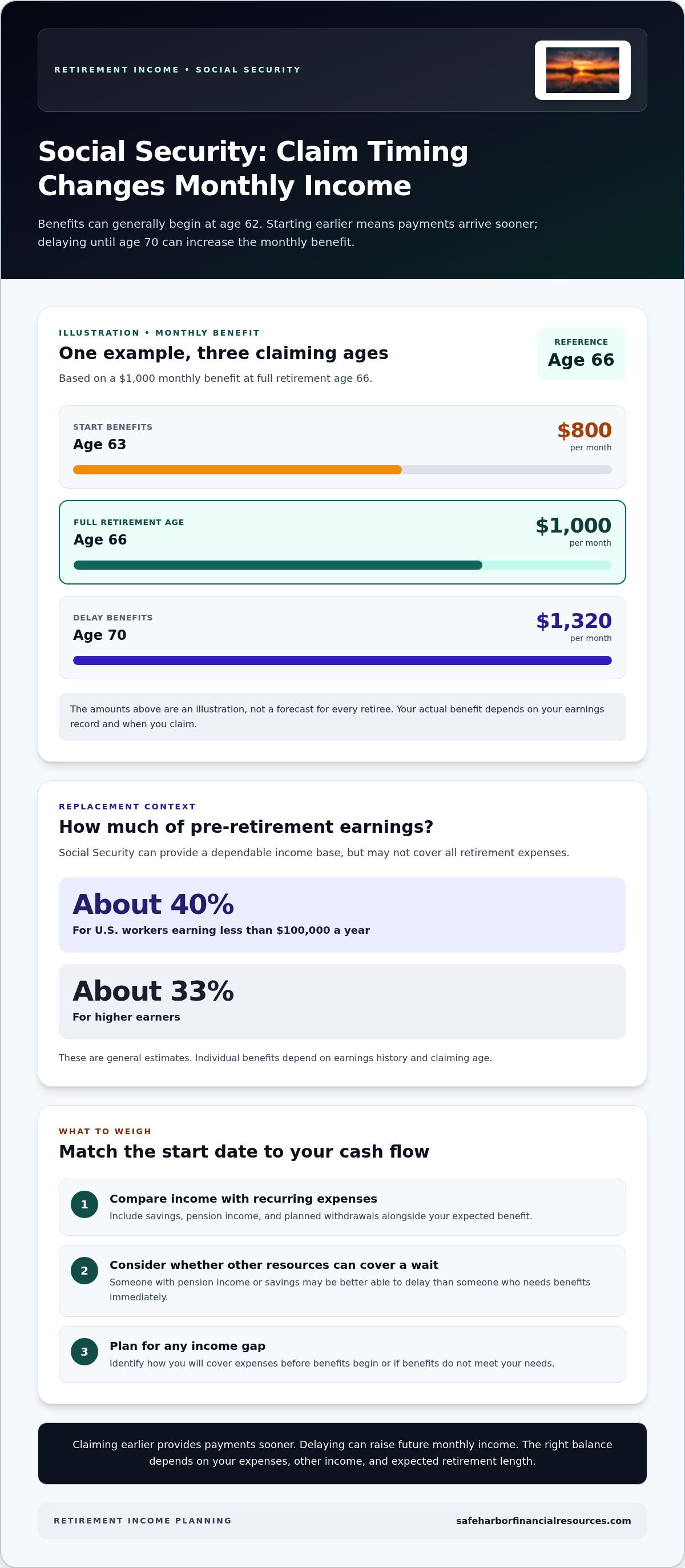
3. How much retirement income can Social Security provide, and when should you claim benefits?
Social Security can provide a dependable income base, but it may not cover all retirement expenses. Benefits replace about 40% of pre-retirement earnings for U.S. workers earning less than $100,000 a year, and about 33% for higher earners. Your actual benefit depends on your earnings record and when you claim.
Retirement benefits can generally begin at age 62, according to the Social Security Administration. Starting earlier can provide income sooner, but generally means a lower monthly benefit than delaying. Retirees can delay starting benefits until age 70 to increase their monthly benefit through delayed retirement credits, according to the Social Security Administration.
Compare timing options with your cash-flow needs, other income, and expected retirement length. For instance, someone with pension income or savings to draw on may be better able to wait than someone who needs benefits immediately. Delaying can raise future monthly income, while claiming earlier provides payments sooner. The right balance depends on how each choice fits essential expenses and other resources.
An illustration based on a $1,000 monthly benefit at full retirement age 66 shows the tradeoff: starting at age 63 would provide $800 per month, while starting at age 70 would provide $1,320 per month. These figures describe that example, not every retiree’s benefit. Use your own projected benefit amounts to compare claim dates and estimate the income gap each choice leaves.
Include your selected Social Security start date in your retirement income strategy, alongside savings, pension income, and planned withdrawals. Compare expected monthly income with recurring expenses, then identify how you’ll cover any shortfall before benefits begin or if they don’t meet your needs.
Safe Harbor Financial Resources: Medicare Supplement Insurance (Medigap)
Safe Harbor Financial Resources can help you understand Medicare Supplement Insurance (Medigap) as you shape your retirement budget. Healthcare coverage is one part of planning expenses alongside Social Security, savings, and other income sources. Reviewing coverage with your broader cash-flow picture can help you see how it fits your retirement plans.
Turn to Safe Harbor Financial Resources when you’re comparing Medicare coverage or want guidance on how a supplement fits alongside your existing plans. The agency also offers life insurance options, including Life Insurance with Living Benefits, Term Life Insurance, and Whole Life Insurance. These address different protection needs rather than replacing a retirement income plan.
For guidance on Medicare Supplement Insurance and its place in your retirement planning, contact Safe Harbor Financial Resources in Palm Beach Gardens.
Make your next retirement decision with clarity
The best way to generate income in retirement is an approach that reflects your priorities, spending needs, and comfort with trade-offs. Before your next move, write down what you want your retirement plan to support, from day-to-day flexibility to protection for loved ones. That gives each financial decision a purpose and helps you see where insurance fits alongside income planning.
Safe Harbor Financial Resources offers Medicare Supplement Insurance (Medigap), Life Insurance with Living Benefits, and Term Life Insurance. These options address healthcare coverage and financial protection, which can be considered as part of a broader retirement plan. A conversation can help you understand how these offerings relate to the priorities you’ve identified.
Contact Safe Harbor Financial Resources to discuss your next step. A thoughtful plan can help you move into retirement with greater clarity and confidence.
Frequently Asked Questions
How do I create income in retirement?
Start by matching dependable income to essential expenses, then decide how to fund flexible spending. List expected payments, account withdrawals, and irregular costs separately. For example, keep travel or home repairs distinct from monthly bills so you can adjust discretionary spending without disrupting necessities. Review the plan after a major change in health, housing, or household income, since each can alter the amount you need.
What are the best ways to generate income in retirement in the U.S.?
The best way to generate income in retirement is usually a coordinated mix, not a single investment or payment. U.S. retirees may combine Social Security, pensions, portfolio withdrawals, annuity payments, part-time work, or rental income. Compare each source by when it begins, how predictable it is, and whether it can keep pace with changing expenses. The combination should reflect your priorities and available resources.
How much can retirees safely withdraw from investments each year?
A systematic withdrawal approach generally distributes 3% to 5% of a portfolio’s total value each year. That range is a planning reference, not a fixed amount suited to every retiree. The withdrawal decision should account for portfolio performance, spending needs, taxes, and how long savings may need to last. Revisit the amount as circumstances change, rather than treating the first year’s withdrawal as permanent.
How do required minimum distributions work, and when must retirees take them?
Required Minimum Distributions are withdrawals required from tax-deferred retirement accounts. According to the Internal Revenue Service, they start at age 73, as stated by its page for 2023. The required amount follows applicable distribution rules, so include it in your yearly cash-flow and tax planning. If the distribution exceeds current spending needs, consider how that additional money fits your broader financial plan.
How can retirees balance income, inflation protection, and investment risk?
Balance these goals by giving investments different roles rather than asking one holding to do everything. Stocks can support long-term growth, while bonds and cash can provide other sources of portfolio income and liquidity. Decide how much volatility your spending plan can tolerate, then review whether the mix still fits your needs. A diversified approach can reduce reliance on any single company or asset type.



Comments