


Two income choices that can help retirement savings last
For a couple in the United States, nearly one in two can expect at least one partner to live to age 90. Planning how to avoid outliving your savings means preparing for a long retirement, not just the first few years. Two options to consider are delaying Social Security, which can increase benefits until age 70, and using an annuity to create a stream of income that can last for life.
It’s understandable to want steady income without relying too heavily on savings. This article explains how delaying Social Security may increase later benefits, how annuities can provide income under their terms, and what to weigh when considering either option. These strategies can support a steadier retirement plan, but the right approach depends on your needs and circumstances.
1. How Can I Ensure I Won't Outlive My Retirement Savings?
A practical starting point for how to avoid outliving your savings is planning for longevity. More than a third of Americans who are 65 today are expected to live to age 90. For a U.S. couple, nearly one in two can expect at least one partner to reach 90. Someone retiring at 65 may need savings or guaranteed income to last 30 years.
Sort expenses into needs, wants, and wishes. Prioritize essentials such as housing, food, and healthcare, then estimate discretionary spending and future goals. This helps you identify which withdrawals must continue during a market downturn and which costs could be adjusted if inflation reduces your purchasing power.
Include account rules and taxes in your U.S. cash-flow plan. According to the Internal Revenue Service, required minimum distributions may be mandatory from pre-tax retirement balances starting between ages 73 and 75, depending on birth year, for people who are no longer working.
There’s no single savings target that works for everyone. Estimate annual expenses, subtract expected Social Security and pension income, and assess how savings withdrawals could cover the gap over a long retirement. This gives your plan a personal starting point.
To make your plan for how to avoid outliving your savings more resilient, match investments to your time horizon and comfort with market swings. Many retirees hold 40-60% of investments in stocks, depending on risk tolerance, with the remainder in fixed-income investments. Consider how inflation and early market losses could affect your strategy.
Map Social Security, pension income, and savings withdrawals against essential expenses. An annuity may also provide payments for life or a set period, creating another potential source of retirement income.
Working longer or part-time can add income and reduce withdrawals. Consulting, seasonal work, or a part-time job may help cover expenses. Review your retirement plan regularly, updating it when your income, spending, health, or assumptions change.
2. Delaying Social Security benefits
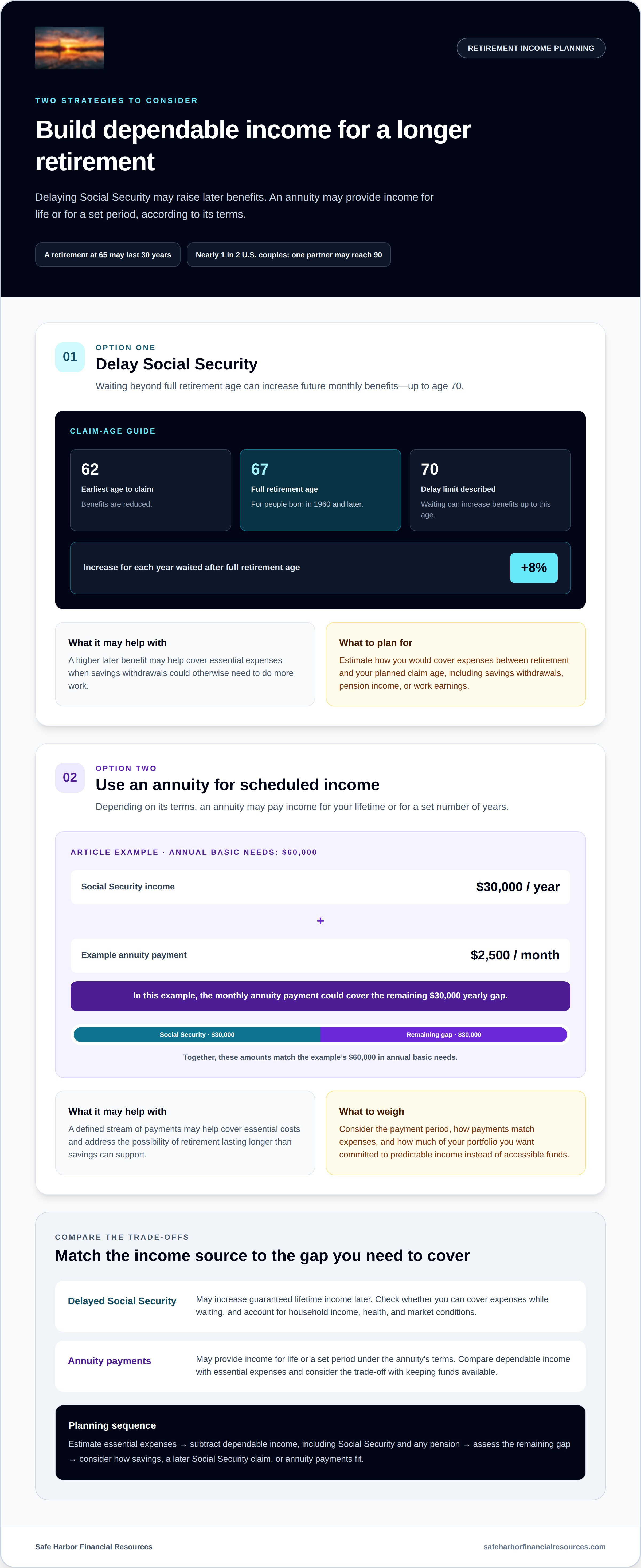
Social Security retirement benefits can begin at different ages, and claiming age affects monthly income. According to the Social Security Administration, benefits can be claimed as early as age 62, with reduced benefits. For people born in 1960 and later, the full retirement age is 67, according to the Social Security Administration.
Waiting beyond full retirement age can increase future income. Social Security benefits can increase by 8% for each year you wait after full retirement age, up to age 70. According to the Social Security Administration, retirement benefits can be delayed until age 70 to increase guaranteed lifetime income. That higher payment may help cover essential expenses later, when withdrawals from savings could otherwise need to do more work.
Use life expectancy estimates as planning guides, not promises. The Social Security Administration estimates that a 55-year-old man can expect to live 28 more years, to age 83, while a 55-year-old woman can expect to live 31 more years, to age 86. Consider how a later claim fits your own health, household income, and ability to cover expenses while waiting.
Before delaying Social Security, estimate the income gap between your planned retirement date and the age you expect to claim. Include pension income, savings withdrawals, and any earnings from work. If investments perform poorly during that period, withdrawals could put added pressure on your savings. Account for both market returns and the timing of Social Security benefits when deciding whether waiting is practical.
Compare claiming earlier with delaying, and revisit the choice as your retirement plan changes. The right strategy depends on cash flow, how long retirement may last, and how much dependable income you want later. A financial professional can help you assess how the timing fits your overall retirement income plan.
3. Annuities as protection against longevity risk
An annuity can convert part of a retirement portfolio into regular income. Depending on its terms, it may provide payments for your lifetime or for a set number of years. This may help address longevity risk, the possibility that retirement lasts longer than your savings can support.
Think of guaranteed income as a floor beneath essential spending, not a replacement for every source of retirement income. For example, if annual basic needs are $60,000 and Social Security provides $30,000, the remaining gap is $30,000 yearly. In this example, a $2,500 monthly annuity payment could cover that difference.
List the expenses you need to cover even if investment returns weaken. Compare those costs with dependable income, including Social Security and any pension. The gap can help you decide whether an annuity may fit your income strategy, while leaving other assets available for flexible spending.
Coordinate the timing with your other retirement choices. Delaying Social Security may increase later benefits, while an annuity may provide income according to its payment terms. Consider how each source fits your expected spending, concerns about outliving your savings, and need for accessible funds.
A financial professional can help you assess whether an annuity fits alongside other income sources. Discuss the payment period, how the income would match your expenses, and how much of your portfolio you want committed to predictable payments. This clarifies the trade-off between a steadier income stream and keeping funds available for changing needs.
Discuss retirement income options to explore how guaranteed payments could fit your plan.
Safe Harbor Financial Resources
Safe Harbor Financial Resources can help you consider how insurance choices fit into your broader financial picture. If healthcare costs or protecting loved ones are concerns, Medicare Supplement Insurance and Life Insurance with Living Benefits may be relevant options to discuss. Start with your needs, expected expenses, and the income sources you’re weighing, including Social Security, savings, and any annuity payments.
Consider reaching out when you want help understanding how these insurance options may support your financial priorities in retirement. Contact Safe Harbor Financial Resources to discuss your questions.
Give your retirement plan a clear next step
A practical approach to how to avoid outliving your savings starts with a plan you can revisit as your priorities change. Consider insurance needs alongside retirement income decisions, rather than treating coverage as a substitute for income planning. Safe Harbor Financial Resources offers Medicare Supplement Insurance (Medigap), Life Insurance with Living Benefits, and Term Life Insurance. Each addresses different needs, so consider the role it could play in your broader financial picture.
If you’d like to talk through your retirement and insurance priorities, contact Safe Harbor Financial Resources. A thoughtful next step can help you move forward with greater clarity and confidence.
Frequently Asked Questions
How Can I Ensure I Won't Outlive My Retirement Savings?
Build an income plan that can adapt as expenses and circumstances change. Separate essential costs from flexible spending, then compare dependable income with each category. Consider how a surviving spouse’s budget might differ or how an unexpected healthcare expense could affect withdrawals. Revisit the plan when income, health, or household needs change, and adjust discretionary spending if savings come under pressure.
How do I estimate retirement expenses and life expectancy?
Start with a monthly budget for housing, food, healthcare, prescriptions, insurance, transportation, and leisure. Use recent spending records to estimate routine costs, then account for irregular expenses such as home repairs. To plan for a long retirement, consider several possible durations rather than relying on one lifespan estimate. This shows how income needs may change if retirement lasts longer than expected.
What is a safe withdrawal rate for retirement savings in 2026?
No withdrawal rate is safe for every retiree. A commonly used guideline starts with 4% of the portfolio in the first retirement year, then adjusts withdrawals for inflation. Some conservative planners suggest an initial rate of 3-3.5% to account for longevity and market uncertainty. The right approach depends on expenses, investment mix, retirement length, and willingness to adjust spending.
How does the 4% rule work, and what are its risks?
The 4% rule uses a first-year withdrawal equal to 4% of retirement savings, followed by inflation-adjusted withdrawals. For example, a $1 million portfolio would provide $40,000 in the first year under this guideline. Poor market returns early in retirement, rising expenses, or a longer retirement can strain the portfolio, so fixed withdrawals may need review.
When should I claim Social Security to maximize lifetime benefits?
Waiting can increase monthly Social Security benefits, with delayed retirement credits available until age 70. The Social Security Administration says benefits may begin at age 62 with reduced benefits, while people born in 1960 or later have a full retirement age of 67. Compare the larger later payment with the income you would give up while waiting, your health, and available savings.



Comments