


How to Get Help Paying for Medicare Part B Premiums
A Medicare Savings Program may help pay your Part B premium, and the Qualified Medicare Beneficiary program may also help with Medicare deductibles, coinsurance, and copayments. If you’re wondering how to get help paying for Medicare Part B, start by checking whether your income and resources meet your state’s eligibility rules. For 2026, the Centers for Medicare & Medicaid Services lists SLMB monthly income limits of $1,616 for an individual and $2,184 for a married couple.
It can be hard to know which program fits, especially when each one covers different costs. This guide explains how Medicare Savings Programs work, what QMB, SLMB, and QI may help pay, and how to apply through your state. You’ll also find the 2026 SLMB resource limits and learn how coverage differs between programs, so you can see which next steps may make sense for your situation.
What are the Medicare Savings Programs?
Medicare Savings Programs are state-run programs that may help eligible people pay Medicare costs. Depending on the program, assistance can cover Part B premiums, deductibles, copayments, and coinsurance.
Finding Programs You May Qualify For
Program screening helps identify assistance that fits your Medicare coverage and finances. A local State Health Insurance Assistance Program (SHIP) offers one-on-one counseling from a trusted, unbiased source. You can also apply for Medicare Savings Programs through your state. QMB may help with Part B premiums and other Medicare costs; SLMB and QI help pay Part B premiums. QDWI helps pay Part A premiums. If your application is denied, follow the review or appeal instructions in the state’s notice. SHIP counseling can help you understand your coverage options. Medicare Savings Program enrollment also automatically qualifies you for Extra Help with Part D prescription costs.
Income and Assets Counted
Income and resource limits help states determine whether an applicant qualifies. For 2026, the Centers for Medicare & Medicaid Services lists SLMB monthly income limits of $1,616 for an individual and $2,184 for a married couple. The resource limit for QMB, SLMB, or QI is $9,950 for an individual and $14,910 for a married couple. States assess resources under their program rules. A home you live in, one vehicle, household items, and burial funds up to $1,500 per person are excluded from assets. These limits help you understand whether applying may be worthwhile.
Medicaid and Part B Premiums
Medicaid is a joint federal and state program that helps cover medical costs for some people with limited income and resources. To seek help with Part B premiums, apply through your state for a Medicare Savings Program. Medicaid may also connect you with Medicare cost assistance, depending on state eligibility rules. If you have both Medicare and Medicaid, you automatically qualify for Extra Help with Medicare prescription drug costs. Extra Help can lower Part D expenses, while an eligible Medicare Savings Program may help pay Part B premiums.
Help paying Medicare premiums, co-pays, and deductibles
Medicare Savings Programs may help eligible beneficiaries pay certain Medicare premiums and cost-sharing. To find out how to get help paying for Medicare Part B, first identify which expenses put the most pressure on your budget.
Medicare Premiums and Cost Sharing
Premiums are charges for coverage; cost-sharing includes deductibles, copayments, and coinsurance. People with Original Medicare may face both types of expenses for covered care. Medicare Savings Programs can help pay Part A and Part B premiums, and some also help with Medicare cost-sharing. A program that pays a premium may not cover every bill.
QMB Premium and Cost-Sharing Help
Qualified Medicare Beneficiary (QMB) provides broad assistance with Medicare-covered costs for eligible people. QMB helps pay Part B premiums and may cover Part A premiums if you do not qualify for premium-free Part A. It also helps pay deductibles, coinsurance, and copayments for Medicare-covered services and items. Medicare providers cannot bill QMB members for these covered cost-sharing amounts, a protection that can matter if you receive a bill after care.
Other Ways to Cover Part B Premiums
SLMB and QI help pay Part B premiums, while QDWI helps pay Part A premiums only. QI funds may be limited, so apply early. Social Security benefits are not a Medicare Savings Program. QMB, SLMB, and QI are the programs that help with Part B premiums. Supplemental Security Income is different: people with Medicare and SSI may automatically qualify for Extra Help with prescription drug costs, not Part B premiums. To decide how to get help paying for Medicare Part B, distinguish state assistance from prescription drug support.
Medicare Advantage and prescription drug coverage raise separate plan questions. Explore Medicare coverage options to consider how plan coverage fits alongside premium assistance.
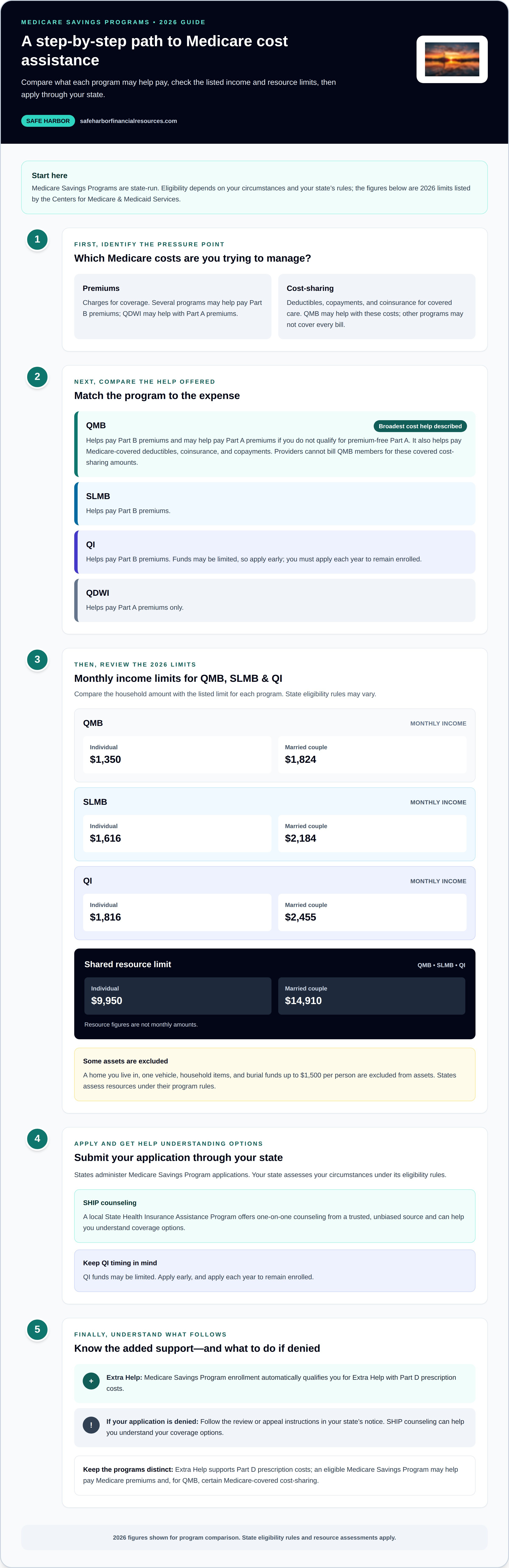
Specified Low-Income Medicare Beneficiary (SLMB) income and resource limits
Medicare Savings Programs use income and resource limits to assess eligibility. The 2026 figures below show how QMB, SLMB, and QI compare.
Comparing Program Income and Resource Limits
Income limits distinguish the three programs, while resource limits can also affect eligibility. According to the Centers for Medicare & Medicaid Services, in 2026 the Qualified Medicare Beneficiary program’s monthly income limit is $1,350 for an individual and $1,824 for a married couple. The SLMB monthly income limits are $1,616 for an individual and $2,184 for a married couple. These limits can help you identify which program may fit your household.
2026 Income and Resource Limits
QI has higher income limits than SLMB, including a married-couple monthly limit of $2,455 in 2026, according to the Centers for Medicare & Medicaid Services. The individual QI monthly income limit is $1,816. For QMB, SLMB, or QI, the resource limit is $9,950 for an individual. For a married couple applying to any of those programs, the resource limit is $14,910, according to the Centers for Medicare & Medicaid Services. The resource figures have no monthly period.
Program Differences and State Rules
SLMB and QI both help pay Part B premiums, but their income limits differ. QI’s higher limit may be relevant if your income exceeds the SLMB threshold. QI funds may be limited, and you must apply each year to remain enrolled. States administer Medicare Savings Program applications, and eligibility rules can vary. Supplemental Security Income (SSI) is a separate Social Security program for certain people with lower incomes. Apply through your state to have your circumstances assessed.
Safe Harbor Financial Resources
Safe Harbor Financial Resources helps Palm Beach Gardens and Palm Beach County residents understand Medicare coverage choices while considering whether a Medicare Savings Program may help with Part B premiums. Guidance on Medicare plans and supplements can clarify how private coverage fits alongside state-administered assistance.
A Medicare Savings Program application and private insurance serve different purposes. Knowing the distinction can help you consider Medicare Supplement Insurance (Medigap) as part of your coverage planning without mistaking it for state premium assistance.
For clear, no-pressure guidance on Medicare coverage options alongside assistance programs, contact Safe Harbor Financial Resources in Palm Beach Gardens to discuss your needs.
Choose a Clear Next Step
Finding out how to get help paying for Medicare Part B starts with separating state assistance eligibility from private coverage decisions. Apply for a Medicare Savings Program through your state; insurance guidance can help you understand how other coverage may fit your needs. Keeping these roles clear helps you focus on the right question at each step.
Safe Harbor Financial Resources offers Medicare Supplement Insurance (Medigap), life insurance with living benefits, and term life insurance. A conversation can help you understand how these insurance options fit your needs without confusing them with state assistance.
Contact Safe Harbor Financial Resources to discuss your coverage questions and consider a steady next step.
Frequently Asked Questions
Do I Qualify for Medicare Financial Assistance?
You may qualify if you have Medicare Part A and meet your state’s income and resource rules. The right program depends on the Medicare costs you need help paying and your financial circumstances. If you exceed one program’s income limit, you may still meet another program’s criteria. Review each available program before ruling out assistance.
Who is Eligible?
People with at least Medicare Part A may apply for a Medicare Savings Program, and most states also set resource limits. Eligibility rules and application processes vary by state, so household finances may be assessed differently across state lines. Supplemental Security Income is a separate Social Security program, not a Medicare Savings Program.
What programs help pay Medicare Part B premiums?
SLMB, QI, and QMB can help pay Medicare Part B premiums. QMB may also help with cost-sharing for Medicare-covered care, while SLMB and QI focus on the Part B premium. QDWI serves a different purpose by helping pay Part A premiums. Match the program to the expense, especially if you need help with more than premiums.
Who is eligible for Medicare Savings Programs in 2026?
In 2026, eligibility depends on having Medicare Part A and meeting the applicable program’s income and resource rules. Your state processes the application and applies its eligibility requirements. QI applicants must apply each year to remain enrolled. If you’re comparing programs, look at both household income and resources, then identify which program’s coverage addresses the Medicare costs you face.
What are the 2026 income and asset limits for Medicare Savings Programs?
According to the Centers for Medicare & Medicaid Services, QMB monthly income limits are $1,350 for an individual and $1,824 for a married couple; SLMB limits are $1,616 and $2,184. QI limits are $1,816 for an individual and $2,455 for a married couple. Resource limits for QMB, SLMB, or QI are $9,950 for an individual and $14,910 for a married couple; the couple limit is according to the Centers for Medicare & Medicaid Services.



Comments