


Living Benefit Riders in Palm Beach Gardens: A 2026 Guide to Security
- dcjrichards
- May 3
- 14 min read
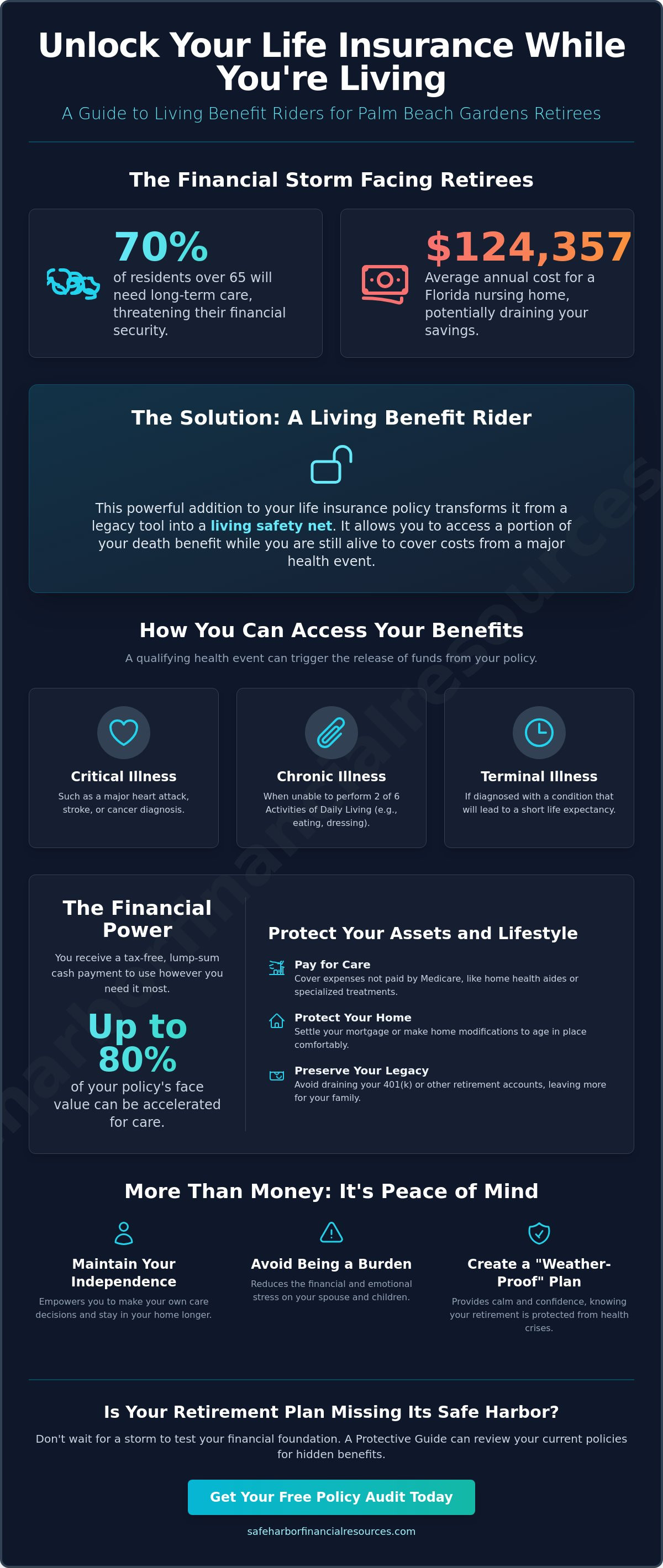
Nearly 70% of Palm Beach Gardens residents who reach age 65 will require some form of long-term care. With Florida nursing home costs averaging $124,357 per year in 2025, it's natural to feel anxious that a health crisis could wash away your hard-earned savings. You might already have life insurance, but a living benefit rider is the essential tool that ensures your policy protects you while you're still here to use it.
We understand that you want to enjoy your retirement in Palm Beach County without the fear of becoming a financial burden to your children. You deserve a plan that feels like a safe harbor, providing stability even when health challenges arise. This 2026 guide will show you exactly how to access your policy funds for medical needs and create a "weather-proof" financial strategy. We'll break down the latest Florida insurance transparency laws and help you find the clarity you need to move forward with total confidence.
Key Takeaways
Understand how a living benefit rider acts as a financial anchor, allowing you to access policy funds for health needs while you're still alive.
Compare the strengths of life insurance "accelerated benefits" against annuity income floors to find the right security for your specific lifestyle.
See why Palm Beach Gardens retirees are choosing hybrid solutions over traditional long-term care to avoid the "use it or lose it" premium trap.
Follow a simple two-step audit to uncover hidden benefits in your current policies and prepare the "tough questions" for your next review.
Discover the value of working with a local "Protective Guide" who prioritizes your peace of mind and provides accurate answers for your retirement plan.
Table of Contents What is a Living Benefit Rider and Why is it Essential for Palm Beach Gardens Retirees? Comparing Life Insurance vs. Annuity Living Benefit Riders in Florida Living Benefits vs. Traditional Long-Term Care: Which Fits Your Palm Beach Lifestyle? How to Evaluate and Add a Living Benefit Rider in Palm Beach County Finding Your Safe Harbor: Personalized Benefit Planning in Palm Beach Gardens
What is a Living Benefit Rider and Why is it Essential for Palm Beach Gardens Retirees?
For decades, many families in Palm Beach Gardens viewed life insurance as a gift for the next generation. It was a legacy tool, something that only provided value once you were no longer here. In 2026, that perspective has shifted. Retirees are now prioritizing "life benefits" because they realize that surviving a health crisis can sometimes be more financially taxing than the crisis itself. A living benefit rider changes the fundamental nature of your policy; it transforms it from a static death benefit into a living, breathing safety net that you can use when you need it most.
At Safe Harbor Financial Resources, we believe your insurance should serve as an anchor during life's storms. These riders are specific provisions added to your policy that allow you to access a portion of your funds while you're still alive. The triggers for these benefits are straightforward. If you're diagnosed with a terminal illness with a short life expectancy, a chronic illness that prevents you from performing daily tasks like dressing or eating, or a critical condition like a stroke or heart attack, your policy can provide a lump sum of cash. This money belongs to you. You can use it to pay for experimental treatments, settle your mortgage, or simply keep your household running while you recover.
The Rising Cost of Aging in Palm Beach County
Living in a beautiful area like Palm Beach Gardens comes with many perks, but the cost of local care is a reality we must face. As of 2025, the average cost for long-term care in Florida reached approximately $124,357 per year. National data for 2026 shows that home health aide services can now cost between $60,000 and $80,000 annually. Many residents find that Medicare and standard health insurance simply don't cover these long-term expenses. A living benefit rider acts as a financial bridge between health insurance and life insurance, filling the gaps that traditional coverage leaves behind. Whether you have a permanent policy or Term life insurance, adding this protection ensures you aren't forced to drain your 401(k) to pay for a home health aide.
Peace of Mind: The Emotional Value of a Rider
The anxiety of becoming a burden to family members is a heavy weight for many retirees in North Palm Beach. By securing a rider, you're not just buying a financial product; you're buying the ability to stay in your own home for longer. It empowers you to maintain your independence and protects your spouse from the exhaustion of being a sole caregiver. We often tell our clients that the time to get "accurate answers" is now, not in the middle of a medical emergency. Having this plan in place replaces confusion with a sense of calm, knowing that your retirement is truly "weather-proof" regardless of what the future holds.
Comparing Life Insurance vs. Annuity Living Benefit Riders in Florida
Choosing the right protection for your retirement requires understanding that not all safety nets are woven the same way. While both options provide security, a living benefit rider functions differently depending on whether it's attached to a life insurance policy or an annuity. In Palm Beach Gardens, where we value both our active lifestyles and our long-term stability, the choice often comes down to whether you need a tax-free lump sum for health emergencies or a guaranteed stream of income that you can't outlive.
Life Insurance Living Benefits: The Health Safety Net
Life insurance riders are primarily designed to protect your assets from being liquidated during a medical crisis. Most modern policies, including many life insurance riders available in 2026, include "Accelerated Death Benefits." This allows you to receive a portion of your death benefit while you're still alive if you face a qualifying health event. For example, verified 2026 standards for Mutual of Omaha riders allow you to accelerate up to 80% of the policy's face amount, typically for a small $100 administrative fee at the time of use.
The "Chronic Illness Trigger" is a common focal point for North Palm Beach families. To qualify, a physician must usually certify that you cannot perform at least two of the six activities of daily living, such as bathing or dressing, or that you have a severe cognitive impairment. This cash is often tax-free, providing a vital resource to pay for care without touching your 401(k) or IRA. If you're unsure which path fits your goals, we can help you compare these options side-by-side during a personal consultation.
Annuity Living Benefits: The Retirement Income Floor
Annuity riders serve a different purpose, acting more like a "Safe Harbor" against market volatility. In the 2026 economy, many retirees use a Fixed Indexed Annuity (FIA) with a Guaranteed Lifetime Withdrawal Benefit (GLWB) to create an income floor. This rider ensures that even if the stock market takes a dive, your "Income Base"—the amount used to calculate your checks—remains protected. It's a way to weather market storms without losing sleep over your monthly budget.
Cost Considerations: As of late 2025, the total expenses for a variable annuity with a living benefit rider can reach approximately 3% per year, with the rider itself costing about 1% of the contract value.
Taxation: Unlike life insurance accelerations, the income from an annuity rider is typically taxed as ordinary income, though a portion may be considered a return of principal.
Access: Annuity riders focus on longevity, providing a steady flow of cash rather than the large lump sum often associated with life insurance health triggers.
Deciding between these two requires looking at your total retirement picture. If your primary fear is a $124,357 annual nursing home bill, a life insurance rider might be your best ally. If you're more concerned about outliving your savings, the annuity route offers the steady hand you need. We're here to provide the accurate answers you need to make this choice with confidence.
Living Benefits vs. Traditional Long-Term Care: Which Fits Your Palm Beach Lifestyle?
Deciding how to fund your future care is one of the most significant choices you'll make for your retirement plan. In Palm Beach Gardens, many retirees find themselves at a crossroads between traditional Long-Term Care (LTC) insurance and the modern living benefit rider. While traditional LTC has been the standard for years, it often carries a "use it or lose it" risk that doesn't sit well with those who want to protect their legacy. If you pay premiums for decades and never require professional care, that money stays with the insurance company. A living benefit rider offers a hybrid solution that ensures your hard-earned dollars provide value regardless of your health outcome.
Flexibility and Control Over Your Care
One of the greatest advantages of a rider is the sheer flexibility it offers for your specific lifestyle. Traditional LTC policies often operate on a reimbursement basis, meaning you must first pay for "approved" services from specific providers and then submit receipts for a refund. Living benefits provide an upfront cash payment rather than a restrictive reimbursement for specific medical receipts. This distinction is vital for residents who want to maintain their independence in North Palm Beach.
You can use this cash for anything that makes your life easier. If you need to modify your home with a ramp or a walk-in tub to stay in the neighborhood you love, the funds are yours to use. If you prefer to have a family member act as a caregiver rather than moving into a facility, the rider allows you to compensate them for their time. You aren't limited by a narrow network of providers; you have the freedom to choose the local Palm Beach Gardens specialists who best meet your needs.
The Hybrid Advantage for Florida Families
For many families, the primary objection to adding extra coverage is the cost. It's a fair concern. In 2025, most Florida residents paid between $2,000 and $3,000 per year for a standalone LTC policy. However, many insurance carriers now include a living benefit rider on their policies at no additional upfront premium. For example, verified 2026 data shows that Transamerica and Mutual of Omaha often include these riders automatically, only charging an administrative fee if you choose to exercise the benefit.
Legacy Protection: If you stay healthy and never trigger the rider, your beneficiaries still receive the full death benefit. Your investment is never "lost."
Simplified Underwriting: Adding a rider to a life insurance policy is often easier than qualifying for a standalone LTC policy, which can have much stricter health requirements.
Predictable Costs: You can structure your policy so that your "living" and "death" needs are covered under a single premium, creating a more stable budget for your retirement.
There are still times when a standalone LTC policy makes sense, particularly if you have a family history that suggests a high likelihood of needing many years of specialized memory care. However, for the majority of retirees looking for a "Safe Harbor" from high Florida care costs, the hybrid approach provides the most balanced protection. We're here to help you weigh these options and provide the accurate answers you need to ensure your plan is truly weather-proof.
How to Evaluate and Add a Living Benefit Rider in Palm Beach County
Securing your future shouldn't feel like a guessing game. Before you consider adding new coverage, your first step is to audit your existing paperwork. To help streamline your organization, you can discover SafeKeep, a secure digital platform for managing your family's most important documents in one central hub. Carriers like Transamerica automatically include terminal illness riders in their 2026 IUL products, while Mutual of Omaha includes accelerated benefits on their Express policies at no extra upfront cost. Finding these hidden gems in your files can save you from paying for duplicate protection.
Once you've identified what you have, you must look at how these benefits interact with Florida's specific regulations. For instance, as of April 2026, the Florida Medicaid income limit for Home and Community-Based Services is $2,982 per month for an individual. If your rider payouts aren't structured correctly, they could inadvertently disqualify you from state-level assistance. We recommend reviewing your strategy alongside the Florida Long-Term Care Partnership Program, which allows you to protect a dollar of assets for every dollar your insurance pays out, keeping your legacy intact.
Asking the Tough Questions
Transparency is the foundation of a secure retirement. We encourage our clients to "Ask us the tough questions" to clear away the confusion. You need to know exactly how your specific policy functions before a crisis occurs. Start with these three inquiries:
What is the elimination period? You need to know if there's a 30, 60, or 90-day waiting period after a diagnosis before funds are released.
How does the "acceleration" work? For example, Mutual of Omaha’s 2026 riders allow for an 80% face amount acceleration, but they charge a $100 administrative fee for each exercise.
What is the impact on my heirs? Accessing $100,000 now will reduce the final death benefit, but the exact math varies by carrier.
The Local Broker Advantage
Working with a local Palm Beach Gardens agency provides a level of protection that national call centers can't match. We understand the local healthcare landscape and the impact of new legislation like Florida House Bill 1263. Effective July 1, 2026, this bill requires insurers to provide detailed rate transparency reports, giving us more data than ever to find you the best value. We don't just look at your life insurance in a vacuum; we look at how it fits with your Medicare Supplement and your overall estate plan.
Our goal is to replace your anxiety with accurate answers. Whether you're navigating the 2026 Medicare Annual Enrollment Period or trying to "weather-proof" your retirement income, we're here to act as your protective guide. Don't leave your security to chance or complex jargon. You can schedule a professional policy review today to ensure your safe harbor is truly ready for whatever the future holds.
Finding Your Safe Harbor: Personalized Benefit Planning in Palm Beach Gardens
Planning for your future shouldn't feel like a high-pressure transaction. At Safe Harbor Financial Resources, we believe that discussing your retirement security requires a steady hand and a neighborly touch. We understand that the fear of high Florida long-term care costs, which averaged $124,357 per year in 2025, can create a sense of unease. Our commitment is to replace that anxiety with a sense of calm through empathy, expertise, and a "customer-comes-first" philosophy. We don't just sell products; we act as a protective guide to help you find the specific living benefit rider that keeps your retirement ship steady.
Our process begins with a simple, low-friction conversation. We sit down with you to understand your health history, your family goals, and your existing coverage. Because many 2026 insurance policies from carriers like Transamerica or Mutual of Omaha include these riders at no upfront cost, we often find that a few strategic adjustments can significantly enhance your protection. We prioritize integrity and transparency, ensuring you have accurate answers before you ever sign a document. It's about transforming insurance from a source of confusion into a reliable personal safety net.
Your 65th Birthday: A Time for Celebration, Not Concern
Reaching age 65 is a major milestone that should be celebrated with family and friends in Palm Beach Gardens. It shouldn't be a time for stress over Medicare enrollment or policy fine print. We specialize in helping new enrollees integrate their health coverage with life insurance that features a living benefit rider. This holistic approach ensures that your plan is "weather-proof" against both market volatility and health challenges. We handle the technical complexity of the 2026 Medicare landscape so you can focus on enjoying the Florida lifestyle you've worked so hard to achieve. We invite you to bring your toughest questions to our office; we have nothing to hide and possess the expertise to handle even the most complex situations.
Next Steps for Your Security
If you're unsure whether your current plan can withstand a health crisis, now is the time to seek clarity. We offer a comprehensive policy audit to see if you can add living benefits to your existing coverage or if a hybrid policy would better serve your needs. This review is especially critical given the 2026 Florida Medicaid asset limit of $2,000 for individuals, as your insurance must be structured correctly to protect your estate. We're here to provide the reassurance and protection you deserve. Take the first step toward a more stable future and Ask us the tough questions during a FREE consultation today.
Secure Your Retirement Anchor Today
Your retirement should be a time of celebration and peace, not a period filled with anxiety over potential health storms. By incorporating a living benefit rider into your financial strategy, you're choosing a path that prioritizes your independence and protects your family from the burden of high care costs. You've discovered that these tools offer a flexible, hybrid solution that works for you while you're still here to enjoy the results of your hard work.
Don't let complex insurance jargon or the confusion of policy fine print keep you from the security you deserve. Our team of licensed Florida insurance professionals is located right here in Palm Beach Gardens, ready to provide the accurate answers you need. We invite you to experience a personalized, nautical-themed "Safe Harbor" policy review that focuses entirely on your unique goals and lifestyle in Palm Beach County.
It's time to replace uncertainty with a plan that's truly weather-proof. We're here to act as your trusted ally every step of the way. Schedule your FREE Safe Harbor consultation in Palm Beach Gardens today and take the first step toward a future anchored in confidence.
Frequently Asked Questions
What is a living benefit rider and how does it differ from a death benefit?
A living benefit rider is a policy provision that lets you access a portion of your insurance money while you're still alive, whereas a death benefit is paid only to beneficiaries after you pass away. It transforms your policy into a source of cash for medical emergencies or long-term care needs. This flexibility ensures your insurance acts as a safety net during your lifetime rather than just a legacy for heirs.
Is a living benefit rider worth the extra cost for a Palm Beach Gardens retiree?
Many modern policies in 2026 include these riders at no additional upfront premium, making them highly cost-effective for retirees. While traditional long-term care insurance can cost between $2,000 and $3,000 per year in Florida, a rider is often only charged an administrative fee if you choose to use it. This makes it an accessible way to "weather-proof" your retirement against rising health costs.
Can I use my living benefit rider to pay for home health care in Florida?
Yes, you can use the cash from a living benefit rider to pay for home health care, modifications to your residence, or any other personal expense. Unlike traditional insurance that might require specific provider networks, these riders provide a lump sum of cash. This allows you to hire local Palm Beach Gardens caregivers or purchase specialized equipment to help you stay in your home longer.
What are the three common triggers for a life insurance living benefit rider?
The three common triggers are terminal illness, chronic illness, and critical illness or injury. Terminal illness usually involves a life expectancy of 12 months or less. Chronic illness triggers occur when you cannot perform two of six daily activities, like bathing or eating. Critical illness covers major events such as a heart attack or stroke, providing immediate financial relief when you need it most.
How much of my life insurance policy can I access through a living benefit rider?
Most carriers allow you to access between 50% and 80% of your policy's face amount. For example, 2026 guidelines from Mutual of Omaha permit an acceleration of up to 80% of the death benefit. It's important to remember that any amount you take while living will be deducted from the final payout your beneficiaries receive later, so we recommend planning carefully with a professional.
Will taking a living benefit payout affect my Medicare or Social Security in Florida?
Living benefit payouts are generally tax-free and don't impact your Social Security benefits, but they can affect Medicaid eligibility. In Florida, the April 2026 income limit for Medicaid home services is $2,982 per month. Because these payouts are considered income or assets, they could push you over the limit. We recommend a professional review to ensure your payout is structured correctly for your estate plan.
Do all life insurance policies in Florida come with living benefits?
No, not all Florida life insurance policies include these benefits automatically, though they are becoming more common in 2026. Older policies or basic term plans may only offer a traditional death benefit. Many top-tier carriers now include them in their Express or Indexed Universal Life products, but it's essential to check your specific policy language to confirm you have this "Safe Harbor" protection in place.
Can I add a living benefit rider to an existing policy I already own?
You generally can't add a living benefit rider to a policy you already own; they must usually be selected at the time of application. However, some permanent policies allow for adjustments during specific life events. If your current coverage lacks this protection, we can audit your paperwork to see if a hybrid policy or a new plan better fits your 2026 security goals.


Comments