

High-Deductible Plan G vs. Plan N: A 2026 Medicare Strategy Guide for Florida Retirees
- dcjrichards
- 2 days ago
- 7 min read
Could the plan with the highest deductible actually be the safest choice for your Florida retirement savings? Many seniors are finding that the traditional route of paying high monthly premiums is no longer the only way to find security. When comparing high deductible Plan G vs Plan N, the decision often comes down to how you prefer to manage your cash flow. It's completely natural to feel a bit of hesitation when you see the 2026 High-Deductible Plan G deductible reach $2,950, but for healthy retirees, the premium savings can be a significant win for your monthly budget.
We understand that you want to protect your hard-earned savings while ensuring you have access to the best medical care. You shouldn't have to choose between a plan that feels too expensive and coverage that leaves you feeling vulnerable. This guide will provide a clear mathematical comparison of these two popular strategies, including how the $283 Part B deductible impacts your 2026 costs. We'll explore how Florida's specific rules on excess charges influence your risk and help you identify which path offers the most reliable refuge for your long-term health and peace of mind.
Understanding the 2026 Medigap Landscape: High-Deductible Plan G and Plan N
Choosing the right coverage feels like finding a safe harbor in a shifting sea. As you look toward 2026, the two most discussed options for savvy retirees are High-Deductible Plan G and Plan N. Think of High-Deductible Plan G as your emergency lifeboat; it stays tucked away with low monthly costs, ready to protect you from a major financial storm. Plan N, by contrast, is more like a steady vessel for regular voyages, offering lower premiums than standard plans while requiring small, predictable contributions for your day-to-day care. Both of these choices fall under the umbrella of Medigap (Medicare Supplement Insurance), which is designed to fill the "gaps" left by Original Medicare.
To help visualize how these options compare, watch this helpful breakdown of your choices:
Deciding between high deductible Plan G vs Plan N requires a look at your personal comfort with risk. While standard Plan G is often called the gold standard for its comprehensive nature, its high-deductible cousin offers the exact same benefits once you reach the annual spending limit. The difference lies entirely in how you prefer to pay for that protection.
The Mechanics of High-Deductible Plan G
With High-Deductible Plan G, you're responsible for the 20% of Part B services that Medicare doesn't pay until you reach the 2026 federal limit of $2,950. It's helpful to remember that Original Medicare still pays its 80% share first; you aren't standing alone against the full bill. Your preventive services remain covered at no cost to you, even before you've spent a single dollar toward that deductible.
The Predictability of Medigap Plan N
Plan N provides a different kind of security. You'll manage small copayments, specifically up to $20 for office visits and up to $50 for emergency room trips that don't lead to an admission. Like standard Plan G, Plan N doesn't cover the annual Part B deductible, which is set at $283 for 2026. This plan is a popular choice for those who want a middle ground between high-deductible risks and high-premium certainties.
Direct Comparison: Costs, Excess Charges, and Financial Risk
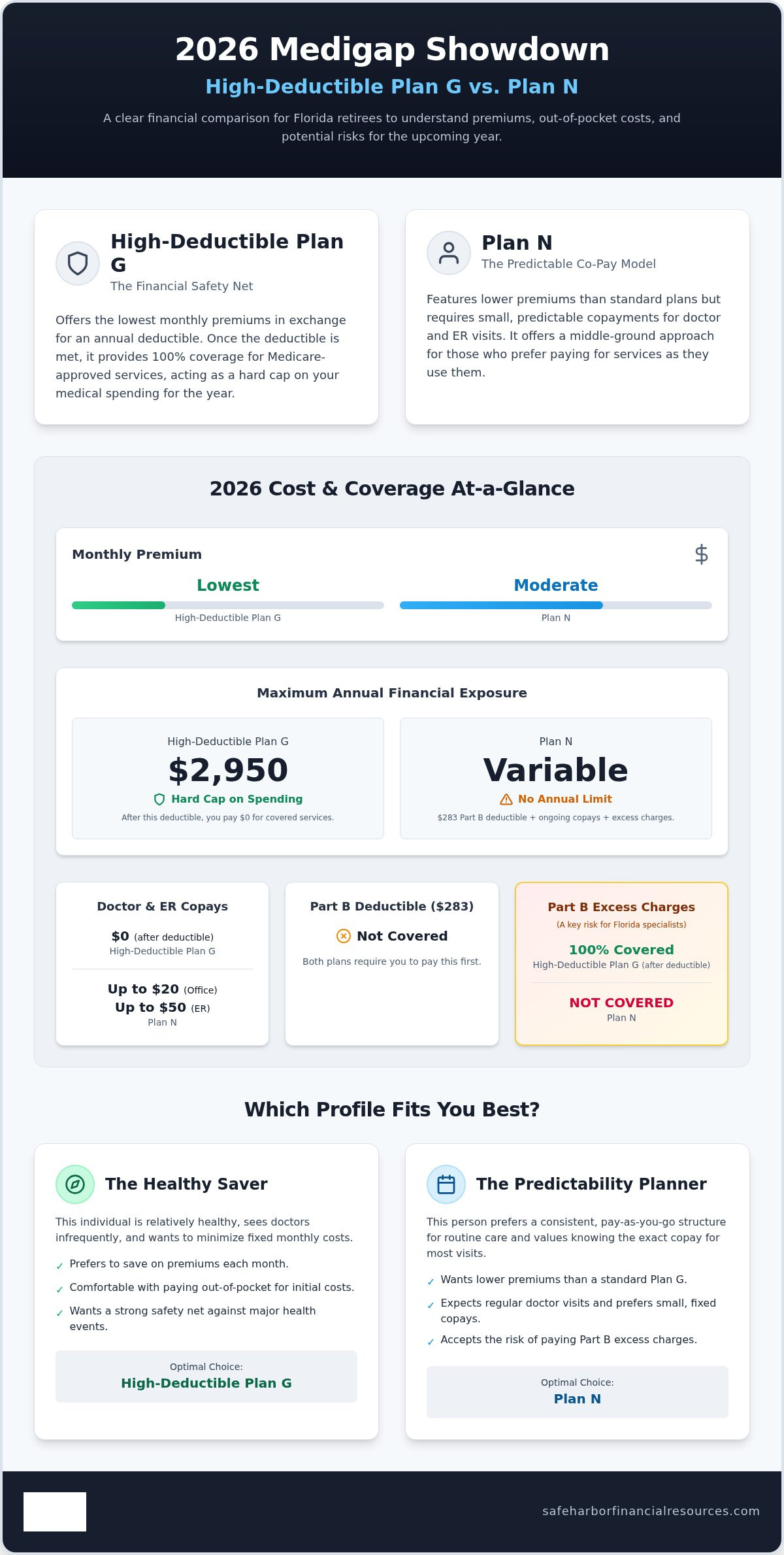
Evaluating high deductible Plan G vs Plan N requires looking past the monthly bill to see the potential storms on the horizon. While Plan N offers lower premiums than standard options, it introduces variables that could impact your long-term security. According to the official Medicare website, these plans are standardized, but the financial risk they carry differs significantly. Here is how they stack up on the essentials:
Monthly Premiums: High-Deductible Plan G typically offers the lowest monthly cost for Florida retirees.
Doctor Copayments: Plan N requires up to $20 per visit; High-Deductible Plan G has $0 copays after you meet the deductible.
Part B Excess Charges: High-Deductible Plan G covers these fully after the deductible is met; Plan N leaves you responsible for the entire amount.
In the medical hubs of Palm Beach County, Part B excess charges can be a hidden reef for Plan N holders if their specialist does not accept Medicare assignment. If the annual premium savings of Plan N are offset by just a few specialist visits and the associated copays, the "value" of the plan can vanish quickly. For those who see doctors frequently, the high-deductible option often provides a clearer path to savings because it eliminates the nickel-and-diming of office visit fees.
The Part B Excess Charge Factor in Florida
An excess charge occurs when a provider bills up to 15% more than the Medicare-approved amount. While many Florida doctors accept assignment, some high-end specialists in areas like Palm Beach Gardens do not. For Plan N holders, these extra costs aren't capped. This can create unexpected financial ripples in an otherwise stable retirement budget, especially during a year when you require specialized care.
Out-of-Pocket Maximums vs. Deductibles
The $2,950 deductible in High-Deductible Plan G acts as a hard cap on your annual medical liability. Once you reach it, your coverage is total. Plan N has no such ceiling for copayments or excess charges. If you face a year with heavy medical needs, the "potential annual cost" of the high-deductible option is often more predictable than the "fixed monthly cost" of Plan N. To see which math works best for your health history, you can request a complimentary professional assessment of your 2026 options.
Decision Framework: Which Plan Secures Your Florida Retirement?
Choosing between high deductible Plan G vs Plan N isn't about finding a universal "best" plan; it's about finding the one that matches your specific rhythm of life. To make this choice with confidence, look back at your last two years of medical claims. If your file is relatively thin, you might be a "Healthy Navigator." This profile often favors High-Deductible Plan G because it allows you to bank significant premium savings every month while keeping a robust safety net for major health events. According to the National Health Expenditure data, healthcare costs continue to climb, making it vital to choose a strategy that protects your long-term capital from unnecessary drain.
If you prefer a "predictable partner" for your health, you might be an "Active Voyager." This profile suits Plan N, where you accept a mid-range premium in exchange for the comfort of knowing a routine doctor's visit will only cost you a small copay. You aren't as concerned with the $2,950 deductible because you'd rather have the insurance carrier shoulder more of the immediate financial load for your regular checkups.
Local Considerations for Palm Beach Gardens Residents
Living in Palm Beach Gardens gives you access to some of the finest medical facilities in the state. However, these top-tier specialists are often the ones who might not accept Medicare assignment, bringing those excess charges mentioned earlier back into focus. Your Medigap choice is just one piece of your overall security. It's equally important to consider protecting assets from nursing home costs to ensure your total retirement remains buoyant regardless of what the future holds.
Your Next Steps for a Secure 2026
We believe these transitions should be celebratory milestones, marking a new chapter of freedom and security rather than a source of stress. You don't have to navigate these waters alone. For a personalized look at the math behind your household's health profile, you can reach out to Dennis Richards on Facebook for expert guidance. A "Safe Harbor" review can help you decide if the premium savings of a high-deductible plan outweigh the predictability of copays, ensuring you never overpay for protection you don't need.
Charting Your Course for a Secure 2026
Your retirement should be a season of relaxation, not a time spent worrying about medical math. Deciding between high deductible Plan G vs Plan N comes down to your personal preference for managing risk. If you prefer to bank monthly savings and only pay when you need major care, the high-deductible route offers a clear path. If you value the comfort of steady, low copays for your regular checkups, Plan N provides that familiar structure. Both choices are valid ways to protect your hard-earned savings while ensuring you have access to Florida's top medical specialists.
Our licensed experts in Palm Beach Gardens are here to act as your emotional anchor during this transition. We provide personalized maritime-themed financial guidance with a deep focus on Living Benefits and long-term security. You shouldn't have to navigate these complex regulatory waters alone. By looking at your specific health history, we can help you identify the mathematical winner for your budget. Request your complimentary 2026 Medicare Supplement assessment with Safe Harbor today to ensure your coverage is a celebratory milestone of security. We look forward to helping you find the perfect refuge for your health and your savings.
Common Questions About Florida Medigap Strategies
Does High-Deductible Plan G cover the Part B deductible?
No, High-Deductible Plan G doesn't cover the annual Part B deductible. You're responsible for paying that initial $283 out-of-pocket for the 2026 calendar year. The good news is that every dollar you pay toward this Part B deductible counts directly toward your larger $2,950 plan deductible. It's a foundational step in reaching your full coverage limit for the year.
Are Part B excess charges common in Florida?
Part B excess charges aren't widespread in Florida, but they aren't prohibited either. State regulations require that if a primary doctor accepts Medicare assignment, any consulting physicians must follow suit unless you agree otherwise in writing. However, certain specialists in medical hubs like Palm Beach Gardens may still bill these extra amounts. This is a key factor when weighing high deductible Plan G vs Plan N, as only the Plan G option fully protects you from these costs.
Can I switch from Plan N to High-Deductible Plan G later?
You can apply to switch plans at any time, but it's rarely a guaranteed move. In Florida, moving from Plan N to another supplement typically requires you to answer health questions and pass medical underwriting. Unless you have a specific "guaranteed issue" right, an insurance company could deny your application based on your health history. It's often safer to choose the plan that fits your long-term needs from the start.
What happens if I hit the $2,950 deductible mid-year?
Once you meet the $2,950 limit, your plan transforms into a total safety net. High-Deductible Plan G will then pay 100% of your Medicare-covered costs for the remainder of the calendar year. You won't have to worry about additional copays or coinsurance for covered services until the deductible resets on January 1st. This hard cap provides the ultimate peace of mind during a difficult health year.


Comments