


Fixed Annuity RMD Rules in 2026: What Retirees Need to Know
Could a fixed annuity trigger required minimum distributions because of the account holding it, rather than the contract itself? The fixed annuity RMD rules can be confusing when scheduled annuity payments overlap with retirement-account withdrawals. The first step is to identify how the annuity is held: a qualified annuity is inside a tax-deferred retirement account, while a nonqualified annuity is generally purchased with after-tax money.
It’s understandable to worry about missing a required withdrawal or taking one twice. This guide explains when RMDs may apply, how an annuity’s tax status and payment terms affect the rules, and what records to gather before you act. Whether you’re reviewing retirement income in Palm Beach Gardens or elsewhere in Palm Beach County, coordinate with your account custodian or tax professional when details are unclear.
Fixed annuity RMD rules: how the account type determines whether distributions apply
Required minimum distribution treatment generally follows the tax-qualified account that holds the annuity, not the annuity’s fixed interest rate. A fixed annuity inside a traditional IRA or eligible workplace retirement plan is generally subject to that account’s RMD rules. By contrast, a personally owned nonqualified annuity bought with after-tax money generally isn’t subject to lifetime RMDs for the owner. The tax treatment of withdrawals from that annuity is a separate question from whether an RMD is required.
This distinction is central to the fixed annuity RMD rules: contracts with similar interest features may have different distribution obligations because they’re held under different tax arrangements. For background on the purpose of Required Minimum Distributions (RMDs), keep the retirement account’s withdrawal rules separate from the annuity contract’s payout terms.
Does a qualified fixed annuity have required minimum distributions?
Generally, yes, if it’s held inside an account subject to RMDs. The IRA or eligible workplace plan brings its distribution rules to the annuity; the contract’s fixed rate doesn’t exempt it. The account custodian or plan administrator can help identify how the RMD is calculated and whether payments already being made under the contract count toward it. Don’t assume that a regular payment covers the full amount due. Compare the payment history with the custodian’s calculation.
Tax status matters more than the fixed-rate feature: the account holding an annuity generally determines whether RMD rules apply.
To understand which rules may fit your situation, gather the annuity statement and contract, identify whether the money is in an IRA or workplace plan, and note any scheduled payments. If ownership or account status is unclear, confirm it with the custodian and consult a tax professional. An insurance professional can help connect the annuity’s role with your broader retirement income strategy, without replacing tax advice.
How to check RMD requirements for a fixed annuity in 2026
A careful review can help prevent a scheduled annuity payment from being mistaken for a complete RMD, or an extra withdrawal from being taken unnecessarily. Start by collecting the account and contract details, then work through these points:
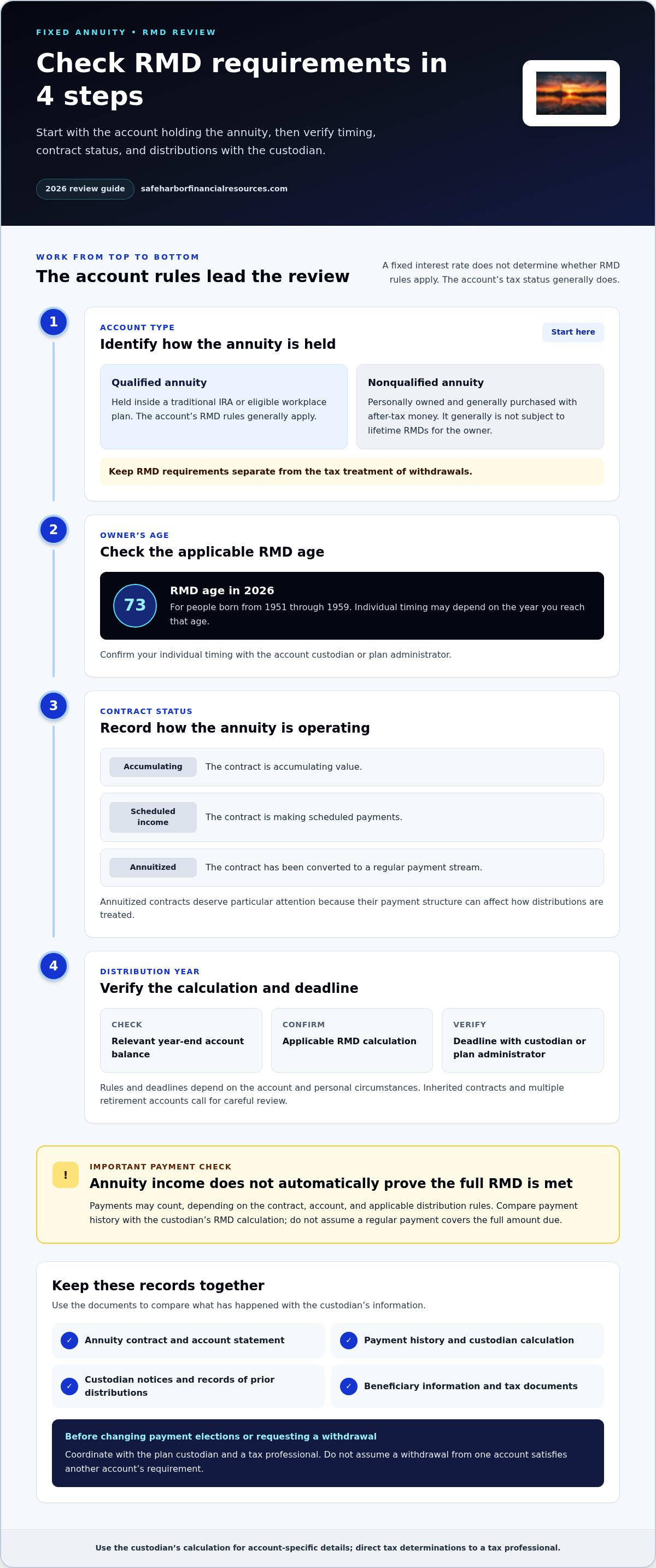
Identify the account type. Check whether the contract is held in a traditional IRA, workplace plan, or personally owned with after-tax funds. The account registration is a key starting point.
Confirm the owner’s age. In 2026, the RMD age is 73 for people born from 1951 through 1959. Individual timing may depend on the year you reach that age.
Review the contract’s status. Record whether it’s accumulating value, paying scheduled income, or annuitized, meaning it has been converted to a regular payment stream.
Pin down the distribution year. Check the relevant year-end account balance, the applicable calculation, and the deadline with the custodian or plan administrator.
RMD calculations and deadlines depend on the account rules and personal circumstances. Annuitized contracts deserve particular attention because their payment structure can affect how distributions are treated. Inherited contracts and multiple retirement accounts also call for a careful review. Don’t assume a withdrawal from one account automatically satisfies another account’s requirement. The Final Regulations on Required Minimum Distributions provide the official regulatory framework, including rules relevant to some plan annuity contracts.
Can annuity payments satisfy an RMD?
They may count, but the answer depends on the contract, account, and applicable distribution rules. Compare payments received with the custodian’s RMD calculation, and confirm which institution reports the distribution and what records to retain. This is especially important if payments come from more than one account.
Receiving annuity income doesn’t by itself prove that your full RMD has been met. Before acting on the fixed annuity RMD rules, gather the contract, account statement, payment history, and custodian calculation. For context on how an annuity may fit into retirement planning, see this overview of an annuity’s role in retirement planning.
Avoid RMD mistakes and fit a fixed annuity into your retirement plan
Buying an annuity doesn’t automatically remove an RMD obligation from a retirement account. The account’s rules still matter, and don’t assume scheduled annuity income satisfies the full distribution requirement without checking the figures. A simple annual review can keep the moving pieces in view and help reduce the risk of a missed or duplicated withdrawal.
Set aside time each year to review:
Upcoming RMD deadlines and the custodian’s calculation
Distributions already taken, including annuity payments
Current account statements and tax documents as they arrive
Any notices about account or contract changes
Keep these records together. If you hold multiple accounts or receive income from an annuitized contract, compare your records with the custodian’s information rather than relying on memory. Tax reporting and whether a distribution meets the applicable requirement are separate questions; direct tax determinations to a tax professional. An insurance professional can help consider how an annuity fits your broader retirement-income needs.
What to review before changing an annuity or taking a distribution
Gather the annuity contract, account statements, custodian notices, records of prior distributions, and beneficiary information. Before changing payment elections or requesting a withdrawal, coordinate with the plan custodian and tax professional. This gives you a clearer view of how a change could affect account distributions, income, and tax reporting under the fixed annuity RMD rules. Keep copies of the guidance and transaction records with your annual review.
Safe Harbor Financial Resources helps individuals explore fixed annuities as part of personalized retirement strategies. Learn about annuities and retirement planning with a focus on how income may fit alongside your other retirement needs.
Build your next retirement decision on a clearer plan
Let the fixed annuity RMD rules guide a careful review, not rush you into changing a contract or taking a distribution. Connect the annuity decision with the retirement income it is meant to support, while directing tax questions to a tax professional.
Safe Harbor Financial Resources assists with fixed annuity placement and personalized retirement strategies from Palm Beach Gardens, Florida. For retirees in Palm Beach Gardens and Palm Beach County, a thoughtful review can help connect an annuity with broader retirement plans and clarify what questions to bring to a tax professional or account custodian.
Explore personalized retirement planning with Safe Harbor Financial Resources to discuss how a fixed annuity may fit into your retirement strategy.
Frequently Asked Questions About Fixed Annuity RMD Rules
Does a fixed annuity have RMDs?
Sometimes. A fixed annuity held inside a traditional IRA or eligible workplace plan generally follows that account’s RMD requirements. A personally owned annuity purchased with after-tax money generally isn’t subject to lifetime RMDs for its owner. For retirees in Palm Beach Gardens and Palm Beach County, checking the account registration is a useful first step in understanding which treatment may apply.
Can fixed annuity payments count toward an RMD?
They may, but don’t assume that receiving regular income means the required amount is fully satisfied. Ask the custodian how payments are counted and reported for the specific account. SECURE 2.0 also permits certain excess payments from qualified annuity contracts to satisfy RMDs from other retirement accounts, subject to applicable rules. Keep payment records and the custodian’s calculation together.
When do I have to take an RMD from an annuity in 2026?
If an RMD is already due for 2026, the usual deadline is December 31, 2026. If you turn 73 in 2026, your first RMD is due by April 1, 2027. Delaying it means taking a second RMD by December 31, 2027, potentially putting two taxable distributions in that year. Confirm your specific deadline with the account custodian.
What happens if I miss an RMD from a fixed annuity?
A missed RMD may trigger an IRS excise tax of 25% of the amount that should have been withdrawn. The rate may be reduced to 10% if you correct the shortfall within two years. If you discover a missed distribution, contact the custodian about the amount and speak with a tax professional about correcting and reporting the error.



Comments