


Questions to Ask About Advisor Pay and Retirement Decisions
The most useful questions to ask your financial advisor about retirement clarify when to claim Social Security, how the advisor is paid, and who could make financial or medical decisions for you if you became unable to. You can claim as early as 62, while the Social Security Administration says full retirement age is 67 for people born in 1960 or later and benefits increase for each month you wait to claim, up to age 70.
It’s reasonable to want advice that puts your interests first, especially when compensation or product recommendations could shape the guidance you receive. Ask how the advisor earns money, whether recommendations could create conflicts of interest, and what a fee-only or fee-based arrangement means for you.
This guide also covers Social Security timing and legal documents that name someone to act on your behalf. With clear questions in hand, you can approach retirement decisions with greater confidence and a better sense of what to do next.
1. Social Security timing: 62, full retirement age, or 70?
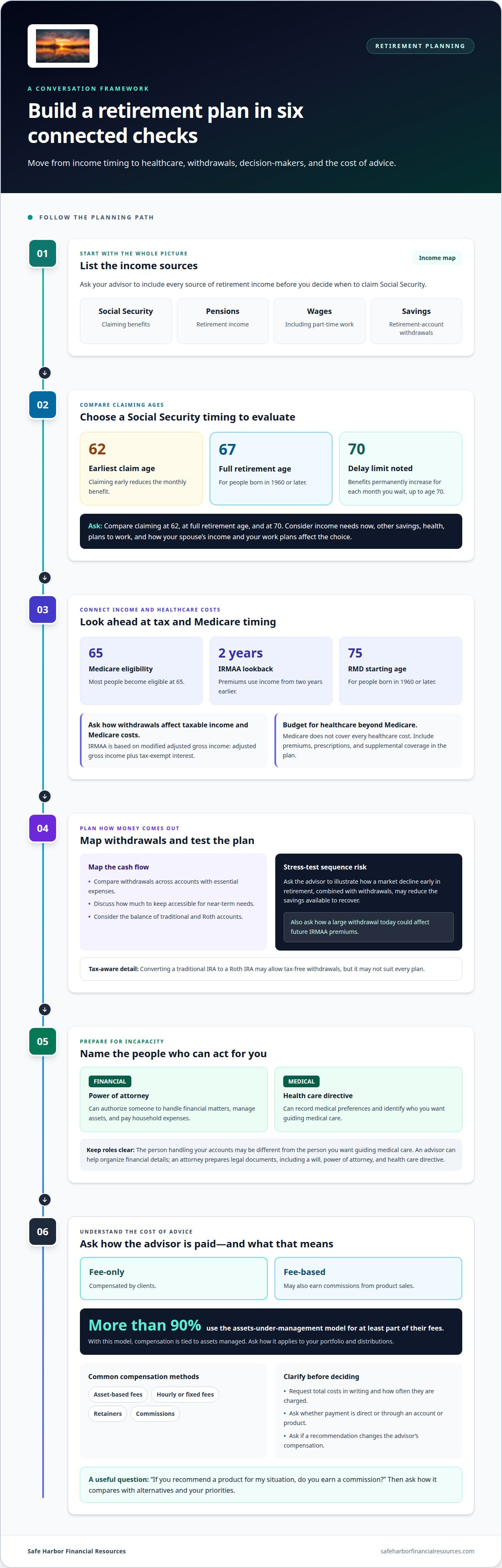
People can become eligible to claim Social Security at age 62, but claiming early reduces the monthly benefit. For people born in 1960 or later, full retirement age is 67, according to the Social Security Administration. The Social Security Administration says your monthly retirement benefit permanently increases for each month you delay claiming, up to age 70.
Ask your advisor to compare claiming at 62, at full retirement age, and at 70, since Social Security retirement benefits permanently increase for each month you wait to claim them. The right strategy depends on your need for income now, other savings, health, and plans to keep working. Also ask how your spouse’s income and your own work plans affect the timing decision.
What retirement income sources should my advisor include in a plan? Ask for a complete picture of Social Security, pensions, wages, and retirement-account withdrawals. If you plan to work part-time, for example, include those wages alongside savings withdrawals before deciding when to claim Social Security.
Your advisor can help align investment choices with when you’ll need the money. Discuss how much to keep accessible for near-term expenses and how longer-term investments support future goals. A tax-aware strategy may also consider the balance of traditional and Roth accounts. Converting a traditional IRA to a Roth IRA may allow tax-free withdrawals, but it may not suit every plan.
How can my advisor help with retirement taxes, Medicare, and required minimum distributions? Ask how withdrawals may affect taxable income and Medicare costs: IRMAA premiums use income from two years earlier, and most people become eligible for Medicare at 65, according to the Centers for Medicare & Medicaid Services. For people born in 1960 or later, required minimum distributions start at 75; planning withdrawals around that age can help account for tax effects. Medicare also doesn’t cover every healthcare cost, so include those expenses in your retirement budget.
2. Choosing people to make financial or medical decisions if incapacitated
A financial plan should address who can act if illness or injury prevents you from communicating. Ask how your estate-planning wishes fit with documents prepared by an attorney. A power of attorney can authorize someone to handle financial matters, while a health care directive can record medical preferences. Make sure your chosen representatives understand your priorities, including how to manage assets and pay household expenses.
Keep decision-making roles clear. The person handling your accounts, for example, may not be the person you want guiding medical care. An advisor can help you discuss your wishes and organize financial details, but an attorney prepares legal documents such as a will, power of attorney, and health care directive.
Include Medicare planning in the conversation. Medicare doesn’t cover every healthcare cost, so ask how premiums, prescriptions, and supplemental coverage fit your retirement income. Consider Medicare Supplement Insurance (Medigap) alongside your Medicare coverage when planning for expenses that affect your budget. Enrollment choices also determine which coverage and costs your plan needs to account for.
Medicare IRMAA premiums are based on modified adjusted gross income, which includes adjusted gross income plus tax-exempt interest. Because the calculation uses income from two years earlier, ask how a large withdrawal today could affect future premiums. This connects your income strategy to healthcare costs, not just taxes.
How will my advisor help manage retirement withdrawals and sequence-of-returns risk? Ask the advisor to map withdrawals across accounts and compare them with essential expenses. The plan can also illustrate how a market decline early in retirement, combined with withdrawals, may reduce the savings available to recover.
3. Advisor compensation and fee-only versus fee-based models
Ask exactly how your advisor is paid, and request a clear explanation of every compensation source. Advisors may charge asset-based fees, hourly or fixed fees, retainers, or commissions. More than 90% use the assets-under-management model for at least part of their fees. With this model, compensation is tied to assets managed, so ask how it applies to your portfolio and distributions.
Fee-only advisors are compensated by clients, while fee-based advisors may also earn commissions from product sales. This distinction matters when an advisor recommends insurance, securities, or mutual funds, because those sales can create conflicts of interest. Ask whether a recommendation changes the advisor’s compensation and how it supports your financial goals.
What are a financial advisor’s fees, and how are they paid? The amount and payment method depend on the arrangement, such as a percentage of managed assets, an hourly or fixed charge, a retainer, or commissions. Ask for the total costs in writing, how often they’re charged, and whether you pay directly or through an account or product.
During a consult, use a practical example: “If you recommend a product for my situation, do you earn a commission?” Then ask how the recommendation compares with alternatives and your priorities. A transparent explanation helps you understand whether advice is shaped by your needs, the advisor’s compensation, or both. Discuss how life insurance fits your retirement plan as part of that broader conversation.
Safe Harbor Financial Resources
Safe Harbor Financial Resources helps Palm Beach County residents consider how Medicare and insurance coverage fit into retirement plans. Alongside questions about Social Security timing, advisor compensation, and decision-making documents, review how healthcare costs and protection needs affect your wider financial picture.
For Medicare coverage, Safe Harbor Financial Resources offers Medicare Supplement Insurance (Medigap) and guidance on Medicare plans. Its life insurance options include Life Insurance with Living Benefits, Term Life Insurance, and Whole Life Insurance. These offerings address insurance needs, while investment decisions, legal documents, and advisor fees remain separate parts of a retirement plan.
If you’re weighing coverage as part of your retirement decisions, contact Safe Harbor Financial Resources to discuss your needs.
Turn your retirement questions into a clear next step
Questions to ask your financial advisor about retirement can guide more than one conversation. Use them to shape an ongoing plan, with clear decisions, responsibilities, and points to revisit as your needs change. A written list can keep your priorities central and make complex choices easier to tackle one at a time.
If you’re reviewing how insurance and healthcare coverage fit into retirement, Safe Harbor Financial Resources can help you explore those needs alongside your broader planning questions. You don’t need every decision settled before starting a conversation. Bring the concerns that matter most and take the next step at a pace that feels right.
Contact Safe Harbor Financial Resources to discuss your retirement and coverage questions. A thoughtful plan can help make the road ahead feel more manageable.
Frequently Asked Questions
Do Others Stand To Gain From The Financial Advice You Give Me?
Potentially, yes. Depending on the arrangement, compensation may come from you, a product provider, or both. An important question to ask your financial advisor about retirement is whether a recommendation generates income for the advisor or firm. Ask who pays, what triggers payment, and whether renewals or product changes affect compensation. Request a plain-language explanation before accepting a recommendation.
How Do I Ensure My Estate and Legacy Plans Are in Order?
Start by listing your assets, intended beneficiaries, and the people you want making financial or medical decisions. Review beneficiary designations on retirement and insurance accounts alongside your will and decision-making documents to ensure they reflect your current wishes. An advisor can help organize financial details and identify questions for an attorney, who can prepare estate-planning documents.
How Much Do I Need to Retire Comfortably?
There’s no single savings target that works for everyone. Estimate essential and discretionary expenses, then compare them with expected income from Social Security, pensions, and account withdrawals. Include housing, healthcare, debt payments, and any plans to keep working. Ask your advisor to model different situations, such as retiring earlier or facing higher expenses, and explain which assumptions have the greatest effect on the results.
How Much Do You Typically Charge?
Financial advisors don’t all charge the same way, so ask for the compensation arrangement and a written breakdown before starting. Clarify whether payment comes directly from you or through an account or product, and what services it covers. Ask whether a recommendation could generate commission or renewal compensation, so you understand the full arrangement, not just one fee.
How Should I Plan for Healthcare and Long-Term Care Costs?
Include healthcare costs in your retirement budget, since Medicare doesn’t cover every healthcare expense. Ask how Medicare coverage, prescription needs, and supplemental insurance fit your situation, and discuss long-term care needs separately rather than assuming Medicare will cover them. For Palm Beach Gardens residents, local guidance on Medicare plans and supplements can help make coverage choices clearer.



Comments