


Indexed vs. Fixed Annuities: A Guide for Florida Retirees
What if the biggest risk to your Florida retirement isn't a sudden market crash, but the quiet erosion of your purchasing power while you sit on the sidelines? You've worked hard to build your nest egg; it's natural to want a protective shield around it. You likely seek a steady stream of income that you cannot outlive, yet the jargon of the insurance world often feels like a thick fog. Understanding how does an indexed annuity differ from a fixed annuity is essential to clearing that path and finding your personal safe harbor.
This guide simplifies these choices, showing you how to balance guaranteed stability with the potential for market-linked growth. We'll compare the predictable nature of fixed rates against the upside opportunities of indexed accounts. You'll gain the clarity needed to anchor your finances in a strategy that respects your risk tolerance and secures your hard-earned future.
The Foundation of Safety: Defining Fixed and Indexed Annuities
Think of your retirement savings as a ship resting in a calm harbor. A fixed annuity serves as a sturdy anchor, providing a guaranteed interest rate for a specific term of years. This predictability offers a sense of calm when you want to know exactly what your balance will be tomorrow. In contrast, an Equity-indexed annuity, or fixed indexed annuity (FIA), links your growth to a market index. While it isn't a direct investment in the stock market, it captures a portion of the gains while keeping your initial principal safe from market losses.
Both options provide tax-deferred growth, meaning you don't pay taxes on earnings until you start taking withdrawals. This is a powerful tool for Florida seniors looking to maximize their nest egg. To understand how does an indexed annuity differ from a fixed annuity, you have to look at their specific roles in your strategy. One provides a steady, rhythmic return; the other offers a protective shield with the chance for higher performance when the market winds are favorable.
To better understand this concept, watch this helpful video:
Predictability vs. Potential: The Core Distinction
Fixed annuities offer a "set it and forget it" approach. They function similarly to a certificate of deposit but include insurance benefits that protect your long term income. You lock in a rate, and your savings grow at that exact pace regardless of global events. It's a reliable tool for Palm Beach Gardens residents who prioritize certainty above all else.
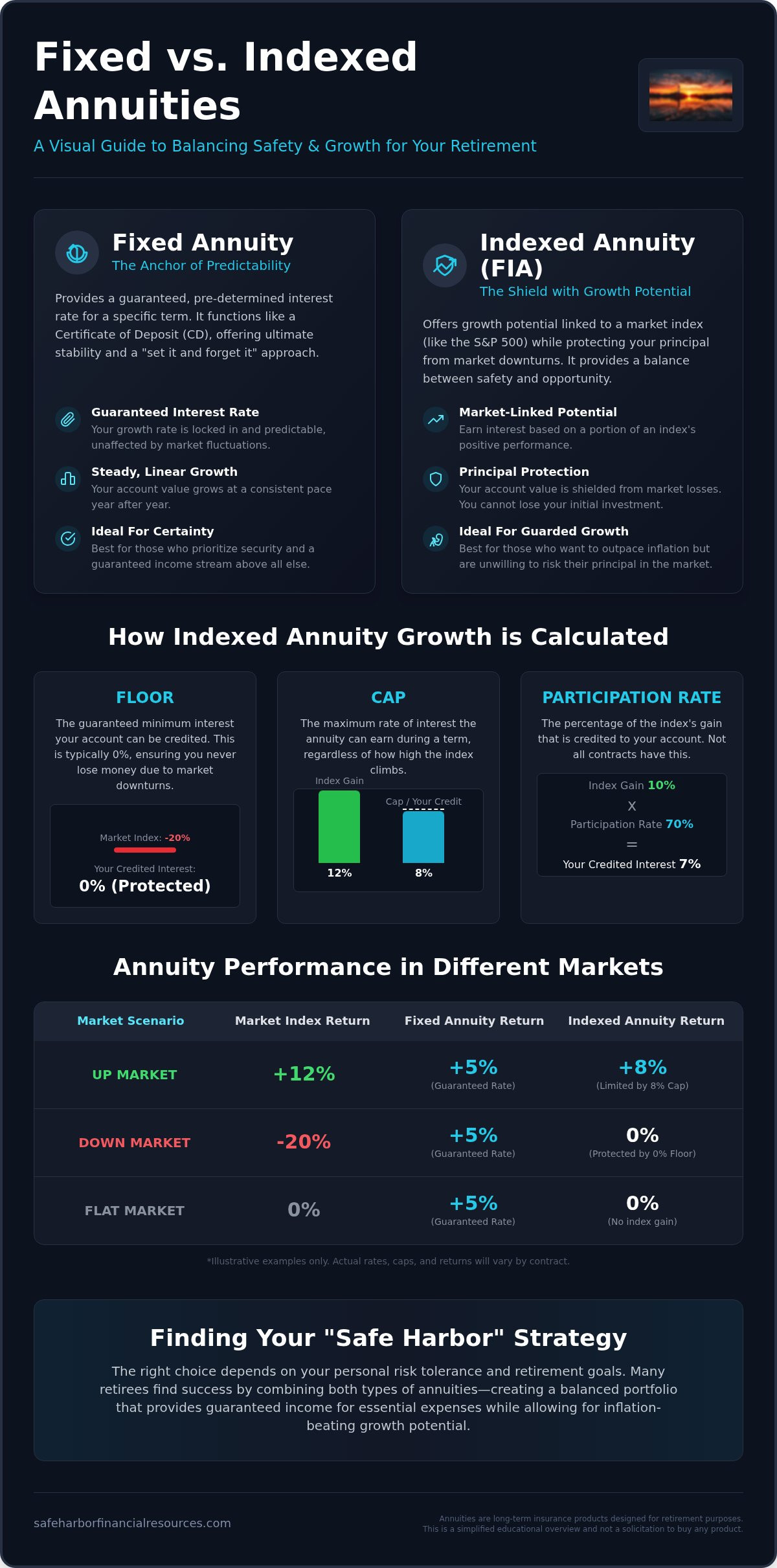
Indexed annuities introduce a different dynamic by offering a floor of 0%. This ensures you never lose money due to market downturns. In exchange for this protection, you accept a "ceiling" or cap on your potential gains. When the market performs well, you participate in that growth. When it dips, your principal remains untouched. This balance helps you pursue growth without the anxiety of a market crash.
While both products offer a refuge from market storms, understanding how does an indexed annuity differ from a fixed annuity requires a closer look at the mechanics of growth. Fixed annuities are the ultimate predictable vehicle. They use a declared interest rate that stays steady for the length of your contract. You know exactly what your account will be worth at the end of the term. This makes them a reliable anchor for those who dislike surprises.
Indexed annuities move slightly higher on the uncertainty scale, though they still prioritize your safety. They utilize a "floor" to ensure that even if the S&P 500 drops by 20%, your account value remains stable. You don't lose your principal, but your interest credits are tied to market performance rather than a flat rate. As noted by FINRA on annuities, these contracts are complex insurance products, not direct investments. When asking how does an indexed annuity differ from a fixed annuity, remember that the choice often comes down to your comfort with fluctuating growth versus a fixed path.
How Indexed Growth is Calculated: Caps and Participation
To manage the balance between safety and growth, insurance companies use specific levers. A Cap is the maximum amount of interest you can earn in a specific period, regardless of how high the index climbs. A Participation Rate determines what percentage of the index's gain is actually credited to your account. Contractually, the Floor is your guarantee that your interest credit will never be less than zero.
Both options require a long term perspective. They typically feature surrender charges for early withdrawals, making them commitments rather than liquid bank accounts. If you feel ready to explore these tools, a complimentary professional assessment can help you determine which lever best fits your retirement timeline and risk tolerance.
Navigating Your Choice: Which Annuity Fits Your Retirement Voyage?
Deciding exactly how does an indexed annuity differ from a fixed annuity depends on whether you value a locked-in rate or a market-linked ceiling. Your choice isn't just about numbers; it's about the life you want to lead in Palm Beach Gardens. If you need a guaranteed paycheck to cover basic expenses, a fixed annuity provides that steady rhythm. However, if you worry that inflation might erode your purchasing power, an indexed annuity offers a chance to outpace rising costs. Many retirees find that a "safe harbor" approach works best. By combining both, you balance absolute certainty with growth potential.
To truly understand how does an indexed annuity differ from a fixed annuity, you have to look at your entire financial horizon. This includes specialized planning like protecting assets from nursing home costs in Florida. Integrating these insurance contracts into a broader strategy ensures that your principal stays safe while your long term needs are met. Local expertise is vital because Florida's regulations offer unique protections for seniors that help you maintain your independence.
The Role of a Professional Guide
A personalized strategy is essential before you sign any contract. Safe Harbor Financial Resources acts as your protective mentor, helping you identify which vehicle matches your specific risk tolerance. We focus on your peace of mind, replacing the stress of complex planning with a sense of calm. Our goal is to ensure you never outlive your income while keeping your hard-earned savings away from market volatility. We prioritize your well-being over high-pressure tactics.
We invite you to join our community on Facebook for regular financial tips and local updates. Every retirement journey is unique, and having a knowledgeable ally makes all the difference in reaching your destination safely. Let us help you navigate these waters with precision and care.
Securing Your Financial Safe Harbor
Choosing your retirement path is a milestone that deserves a celebratory, stress-free approach. Whether you value the stability of a fixed rate or the growth potential of an indexed account, the goal is long-term security. Understanding how does an indexed annuity differ from a fixed annuity empowers you to select the vehicle that best protects your principal. By balancing these tools, you can weather any market storm with confidence.
Safe Harbor Financial Resources provides maritime-themed guidance for Palm Beach Gardens seniors. We act as your steady guide, ensuring your retirement voyage remains on course. If you're ready for clarity, Request Your Complimentary Retirement Assessment at Safe Harbor Financial Resources today. Your peace of mind is our priority; let's anchor your legacy together.
Frequently Asked Questions
Can I lose money in a fixed indexed annuity if the stock market crashes?
No, you won't lose your initial investment or previously credited interest due to a market downturn. These contracts include a contractual floor, usually 0%, which acts as a protective shield for your principal. While you won't see gains during a crash, your balance remains steady. This feature is a primary reason why many Florida seniors choose them for long-term peace of mind.
How does an indexed annuity differ from a variable annuity?
The main distinction lies in risk and protection. A variable annuity places your money directly into market subaccounts, meaning your balance can drop if the market fails. When asking how does an indexed annuity differ from a fixed annuity or a variable one, remember that indexed products provide a safety net. They offer growth potential without the risk of losing your principal.
What is the typical length of an annuity contract in Florida?
Most annuity contracts in Florida feature surrender periods ranging from three to ten years. During this time, your funds are intended for long-term growth. Florida regulations provide specific protections for seniors age 65 and older, including a 21-day "free look" period. This allows you to review the commitment and ensure it serves as the right anchor for your financial future.
Are annuity withdrawals taxed as capital gains or ordinary income?
Annuity withdrawals are taxed as ordinary income rather than capital gains. Since Florida has no state income tax, you'll only be responsible for federal taxes on the interest earned. This tax-deferred status allows your savings to grow more efficiently over time. It's helpful to consult with a professional to understand how these distributions fit into your overall retirement tax strategy.


Comments