


How Much Life Insurance Do I Need? A Calculator Guide
What if a familiar income multiplier gives you a number that doesn’t fit your household? It can be a useful starting point, but debts, future plans, savings, and coverage through work can all change the estimate. A search for “how much life insurance do I need calculator” is often really a search for a clear way to weigh those pieces.
You don’t need a perfect number to begin. This guide walks through a practical estimate: add the financial needs you want to protect, such as income replacement, debts, mortgage payments, and education goals, then subtract resources available to your family. You’ll also see why employer coverage and savings need a closer look before reducing your estimate.
Use the calculation as a transparent starting point, not a one-size-fits-all answer. Keep track of the assumptions that shape the result, then review them before comparing policy types or seeking guidance. If you’re in Palm Beach Gardens or elsewhere in Palm Beach County, Safe Harbor Financial Resources can help you discuss life insurance options.
How Much Life Insurance Do I Need? Start With a Needs-Based Estimate
A calculator can give you a useful estimate, but it can’t produce a universal answer or a personalized recommendation. Your household’s needs and resources shape the result. Start by listing the financial needs you want coverage to address, then subtract resources available for those same needs. If you’re new to the basics, this overview of what life insurance is explains how coverage and death benefits work.
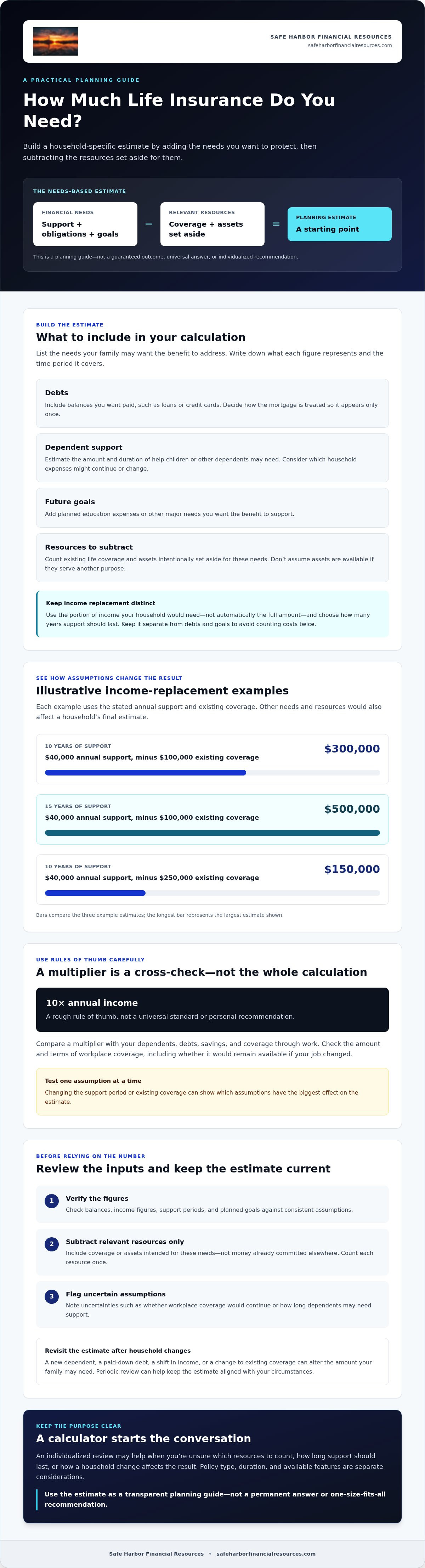
A life insurance needs estimate is the financial support your household may need, minus resources set aside to provide it. Treat the result as a planning guide, not a guaranteed outcome or individualized recommendation.
A how much life insurance do I need calculator is most useful when you enter household-specific figures rather than relying only on a broad income multiple. Write down what each number represents, including the time period it covers. Avoid counting the same obligation twice, such as including a mortgage in both total debts and housing costs.
Which numbers should you enter in a life insurance calculator?
Start with the obligations and goals your family might need help meeting:
Debts: Include balances you want paid, such as loans or credit cards. Decide how you’re treating the mortgage so it appears only once in the estimate.
Dependent support: Estimate the amount and duration of financial help children or other dependents may need. Consider which household expenses would continue and which might change.
Future goals: Add planned education expenses or other major needs you want the benefit to support.
Resources: Subtract existing life coverage and assets you’ve intentionally set aside for these needs. Don’t assume every asset is available if it serves another purpose.
For income replacement, enter the portion of income your household would need, not automatically the full amount. Then choose how many years that support should last. For example, a household that needs part of your income for a limited period will arrive at a different estimate than one relying on most of it for longer. Keep this estimate separate from debts and goals so you don’t include the same costs in more than one category.
How to Adjust Your Life Insurance Calculator Result for Real Life
An income multiplier can offer a quick sense of scale, but it skips details that make your household different. A family with several dependents, substantial debt, and little existing coverage may need a different estimate from a household with fewer obligations, savings set aside, or employer coverage. Treat the multiplier as a comparison point, then check whether its implied support period and resources match your situation.
A calculator result is only as useful as the inputs and assumptions behind it. Try changing one figure at a time, such as the years of support or the amount of coverage already in place. This can show which assumptions have the biggest effect. The example below isolates income replacement; other needs and resources would also affect the final estimate.
Does the 10-times-income rule fit every household?
Not necessarily. Ten times annual income is a rough rule of thumb, not a universal standard or personal recommendation. Use it as a cross-check, then compare it with your household’s dependents, debts, savings, and coverage through work. If you’re exploring the how much life insurance do I need calculator question, the Life Insurance Needs Calculator can help you test household inputs. Count each resource only once, and check the amount and terms of workplace coverage, including whether it would remain available if your job changed.
After testing your assumptions, an individualized review can help you make sense of the estimate before considering policy options. You can learn more about life insurance guidance as a next step.
What to Do After Calculating Your Life Insurance Needs
Your estimate is a starting point. Before relying on it, review each entry and make sure the figures reflect the needs you actually want coverage to address. Check for outdated amounts, missing obligations, and resources counted more than once.
Verify the inputs: Check balances, income figures, support periods, and planned goals. Make sure each amount is based on the same assumptions you used throughout the calculation.
Subtract relevant resources only: Include existing coverage or assets intended for these needs, not money already committed elsewhere.
Flag uncertain assumptions: Note whether workplace coverage would continue or how long dependents may need support.
Revisit your estimate after a major household change. A new dependent, a paid-down debt, a shift in income, or a change to existing coverage can alter the amount your family may need. Even without a major event, reviewing the figures periodically can help keep the estimate aligned with your circumstances. That’s more useful than treating one calculator result as permanent.
When should you review your estimate with a licensed professional?
Consider a conversation if you’re unsure which resources to count, how long support should last, or how a change in your household affects the result. The coverage estimate is only one decision. Policy type, duration, and available features are separate considerations, and the right questions depend on your needs and circumstances.
Safe Harbor Financial Resources offers term, whole, and universal life insurance. If you’d like to review your estimate and discuss which options may be worth exploring, you can discuss your life insurance options with the agency. A conversation can help you check your assumptions without treating a calculator result as a final answer.
Take the Next Step Toward a Clearer Coverage Plan
A useful estimate starts with your household’s needs, then accounts for resources already in place. Treat the how much life insurance do I need calculator result as a guide, not a final answer, and revisit it when your family, finances, or coverage changes. Check uncertain assumptions before deciding how much protection to consider.
Once you have a working estimate, policy type and duration are separate decisions to explore. Safe Harbor Financial Resources is an independent agency owned and operated by licensed insurance professionals, based in Palm Beach Gardens, Palm Beach County. Its life insurance options include term, whole, and universal life insurance, as well as products with living benefits.
Discuss your life insurance options and review your estimate in an educational conversation. A clearer picture of your needs is a reassuring place to begin.
Frequently Asked Questions
How much life insurance do I need if I have children?
Estimate the financial support your children may need if your income were no longer available. Consider how long they may depend on you, everyday household expenses, debts you want covered, and planned education costs. Then account for existing life coverage and assets set aside for those needs. The result depends on your family’s circumstances, so use a calculator as a starting estimate, not a fixed rule.
Is the 10-times-income rule enough to calculate life insurance needs?
Not for every household. Ten times annual income is a rough rule of thumb, but it may not reflect your dependents, debts, savings, or coverage through work. A household with few obligations may need a different amount from one supporting several dependents. Use the rule as a comparison, then try a how much life insurance do I need calculator with your actual needs and resources.
Should I subtract savings and employer life insurance from my estimate?
Subtract resources only if they’re intended and realistically available to meet the needs in your estimate. Savings reserved for education or emergencies may not be fully available for other obligations. Check the amount and terms of employer life insurance, including whether it would remain available if your job changed. Count each resource once, and don’t subtract assets already assigned to another goal.
How often should I recalculate how much life insurance I need?
Revisit your estimate after a major change, such as having a child, paying down debt, changing income, or gaining or losing existing coverage. A regular review can also help you catch outdated assumptions. If you’re unsure how a change affects your needs, Safe Harbor Financial Resources, an independent agency in Palm Beach Gardens, Palm Beach County, can help you review the estimate and discuss life insurance options.


Comments