


Annuity RMD Rules: Navigating Retirement Distributions in 2026
- dcjrichards
- Aug 5
- 7 min read
Did you know that missing a single retirement distribution in 2026 could cost you a staggering 25% of that money in IRS penalties? It's a stressful thought for anyone who has spent decades carefully building a nest egg; the fear of making a technical mistake that drains your hard-earned savings is completely valid. You've worked hard to reach this milestone, and you deserve to feel like your financial future is anchored in calm waters rather than tossed about by confusing regulations.
The good news is that you don't have to face these changes alone. By mastering the 2026 annuity rmd rules, you can protect your retirement harbor from unnecessary tax penalties and ensure your "safe harbor" remains secure. This article provides a clear roadmap for compliance, explains how the SECURE 2.0 Act impacts your specific accounts, and shows you how fixed annuities can simplify your tax burden while providing the stability you need to enjoy your golden years with confidence. We will walk through the exact steps to keep your plan on course and your peace of mind intact.
Understanding Annuity RMD Rules: Qualified vs. Non-Qualified
A Required Minimum Distribution (RMD) is the smallest amount you must withdraw from your retirement accounts each year. The IRS creates these rules to ensure that the tax-deferred growth you've enjoyed eventually becomes taxable income. For many seniors, understanding annuity rmd rules is the key to maintaining a steady course through their retirement years without hitting unexpected tax snags.
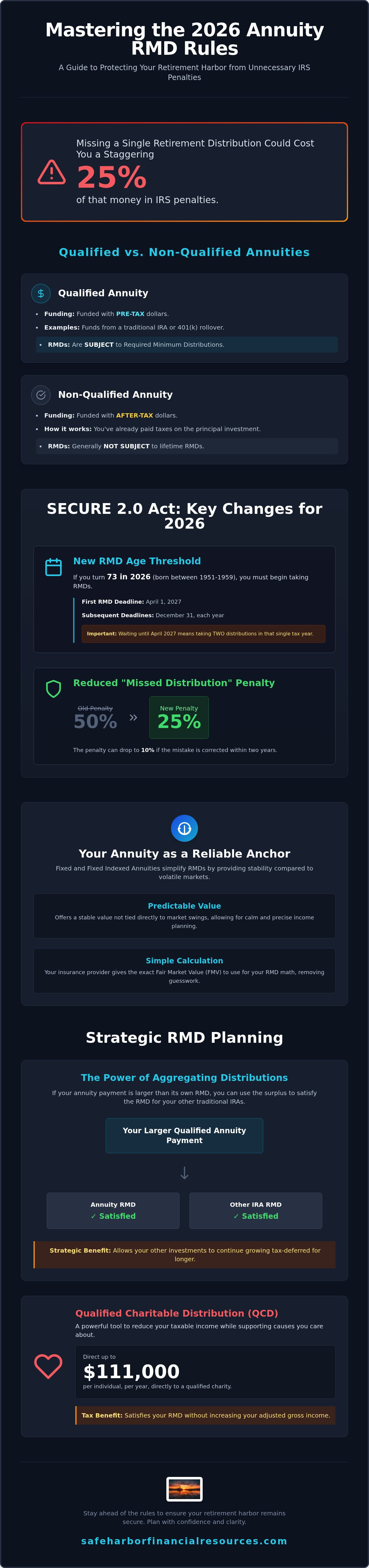
Whether you need to take a distribution depends largely on how you funded your contract. Qualified annuities, which are funded with pre-tax dollars from accounts like a traditional IRA, are subject to these mandates. On the other hand, non-qualified annuities are funded with after-tax dollars; because you've already paid taxes on the principal, the IRS generally doesn't require lifetime distributions from these specific accounts.
To better understand how these distributions work within your financial plan, watch this helpful video:
The 2026 RMD Age Thresholds
The SECURE Act 2.0 has shifted the landscape for when you must begin your withdrawals. If you turn 73 in 2026, which applies to those born between 1951 and 1959, you've reached your first major milestone. You have until April 1, 2027, to take your first distribution, though waiting until that date means you'll have to take two distributions in a single tax year. For all subsequent years, you must complete your withdrawal by December 31 to avoid a 25% penalty on the amount you should have taken. Staying ahead of these annuity rmd rules ensures your retirement harbor stays protected from these steep costs.
Why Your Annuity Type Matters
Fixed Annuities and Fixed Indexed Annuities act as a reliable anchor because they offer a predictable value compared to the choppy waters of the stock market. This stability makes calculating your annual obligation much simpler. Your insurance company will provide the Fair Market Value of your contract, which serves as the baseline for your annual RMD math. Because these products aren't tied directly to market swings, you can plan your income with a sense of calm and precision. This predictability allows you to focus on celebration rather than calculation as you enter this new stage of life.
How SECURE 2.0 Changes Annuity RMD Calculations
The SECURE 2.0 Act isn't just about shifting dates; it's about making your retirement assets work together more effectively. Think of your qualified annuity as the lead ship in your retirement fleet. It clears the path, helping you manage annuity rmd rules with greater ease by acting as a primary source of required income. According to the IRS RMD FAQs, these modern regulations allow you to aggregate your distributions in ways that were previously restricted.
For contracts that haven't been "annuitized" into a lifetime income stream yet, your insurance provider will report the Fair Market Value (FMV) annually. This precise figure serves as the baseline for your calculations, ensuring your math remains accurate. By using the predictable value of Fixed or Fixed Indexed Annuities, you can satisfy your obligations without the stress of market volatility affecting your required withdrawal amounts.
The Benefit of Aggregating Distributions
This new flexibility is a significant win for your long-term security. If your annuity payment is larger than the RMD specifically required for that contract, you can often use that surplus to satisfy the requirements for your other traditional IRAs. This "excess payment" rule means you can leave your other investments alone, allowing them to continue growing tax-deferred for a longer period. It's a strategic way to protect your broader portfolio while still meeting your legal obligations to the IRS.
Avoiding the 25% 'Missed Distribution' Penalty
Accuracy is your best defense against unnecessary costs. The SECURE 2.0 Act reduced the penalty for a missed distribution from 50% down to 25%. If you discover a mistake and correct it within two years, that penalty can even drop to 10%. However, the most reassuring strategy is to avoid these penalties entirely. We recommend a "Safe Harbor" approach by automating your distributions. This ensures you never miss a deadline and your retirement remains a source of celebration. If you're feeling uncertain about your specific thresholds, reaching out for a professional assessment can help ensure your fleet stays on course.
Strategic RMD Planning for Palm Beach Gardens Seniors
Reaching the age where you must begin taking distributions isn't a burden; it is the celebratory harvest of your life's work. You've spent decades navigating the professional seas to build this security. Now, understanding the annuity rmd rules allows you to enjoy that bounty while keeping your tax obligations in check. For those looking to reduce their taxable income in 2026, the Qualified Charitable Distribution (QCD) remains a powerful tool. You can direct up to $111,000 per individual directly to a qualified charity, satisfying your requirements without increasing your adjusted gross income. This approach follows the latest IRS RMD rules while supporting the causes you care about most.
Legacy and Living Benefits in Florida
Your mandatory income can also serve as a protective shield for your family. Many Palm Beach County retirees choose to pivot their RMD proceeds into Life Insurance with Living Benefits. This strategy provides a double layer of security. It creates a tax-free legacy for your spouse while offering access to funds for potential nursing home costs or chronic illness. In Florida, where long-term care can be a significant concern, these "Living Benefits" transform a mandated withdrawal into a proactive defense for your retirement harbor. It's a way to turn a tax requirement into a lasting gift of security.
Your Local Safe Harbor
Planning for your future should feel like finding a calm refuge. Working with a local expert who understands Florida-specific insurance regulations ensures your strategy is built on a foundation of precision and empathy. We invite you to visit our Palm Beach Gardens office for a professional review of your retirement chart. You don't have to navigate these choppy regulatory waters alone. Our team is here to provide the clarity you need to ensure your "safe harbor" remains secure for years to come. If you're ready to chart your course with confidence, reach out for a complimentary professional assessment today.
Charting Your Course to a Secure Retirement
Transitioning into the RMD phase of your life shouldn't feel like entering a storm. By understanding the 2026 annuity rmd rules, you've taken the first step toward turning a complex regulation into a manageable part of your financial plan. You now know how to distinguish your account types and how the SECURE 2.0 Act allows for smarter aggregation across your retirement fleet. These tools exist to keep your savings protected and your tax burden predictable.
Our team of licensed Florida insurance professionals is here to act as your steady guide. We specialize in Fixed and Fixed-Indexed Annuities, helping you design personalized retirement income strategies that prioritize your peace of mind. Whether you're looking to shield your spouse with living benefits or reduce taxable income through charitable giving, we can help you navigate these waters with precision. You've worked hard for your savings, and it's our privilege to help you protect them.
Schedule Your Complimentary RMD Assessment with Our Palm Beach Gardens Team
Your hard-earned retirement deserves the protection of a safe harbor. We look forward to helping you celebrate this milestone with clarity and confidence.
Frequently Asked Questions
What is the RMD age for annuities in 2026?
In 2026, the age you must begin taking distributions depends on your birth year. If you were born between 1951 and 1959, your required age is 73. If you were born in 1960 or later, that threshold increases to 75. This delay is a reason for celebration, as it gives your savings more time to grow within your protective retirement harbor before you begin your withdrawals.
Can I use my annuity payment to satisfy RMDs for my 401(k)?
No, you cannot use your annuity payments to satisfy the requirements for a 401(k) or other employer-sponsored plans. While the IRS allows you to aggregate distributions across multiple IRAs, 401(k) accounts are treated as separate vessels. You must calculate and withdraw the required amount from each employer plan individually to ensure you remain in safe waters and avoid costly tax penalties.
What happens if I forget to take my RMD from a qualified annuity?
Missing a distribution triggers a 25% IRS penalty on the amount you failed to withdraw. However, if you act quickly and correct the mistake within two years, that penalty can be reduced to 10%. Mastering these annuity rmd rules with the help of a steady guide is the best way to prevent these errors and protect your hard-earned savings from being drained by avoidable tax hits.
Do non-qualified annuities have required minimum distributions?
Non-qualified annuities generally don't require lifetime minimum distributions because they are funded with after-tax money. Since you've already paid taxes on the principal, the IRS doesn't force you to take withdrawals during your lifetime. This provides a sense of calm and flexibility, as you can decide exactly when to access your income based on your own life transitions rather than a mandated government schedule.


Comments